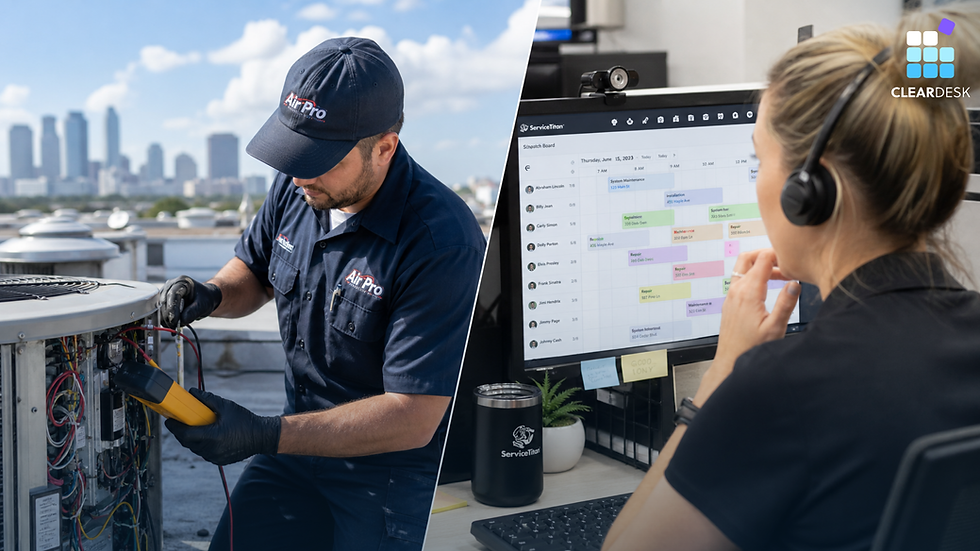
Best Virtual Assistants for HVAC and Plumbing Companies
- Princess Villan

- Apr 10
- 23 min read
Updated: Jul 6

Quick Summary
Cost savings: Virtual assistants reduce staffing costs by 60% compared to local hires while maintaining service quality
Revenue impact: Proper dispatch coordination increases technician billable hours from 6 to 8+ hours daily
Response time: VAs ensure 100% call coverage, preventing missed leads that cost $200-500 per lost opportunity
Growth capacity: Companies using VAs scale 40% faster without proportional overhead increases
Industry focus: Specialized HVAC and plumbing VAs understand ServiceTitan, Jobber, and industry terminology
HVAC & Plumbing Virtual Assistant Roles (What to Delegate + KPIs to Track)
Understanding which tasks to delegate and how to measure success is critical for maximizing the value of virtual assistants in home service operations. The table below outlines the most common VA roles, their core responsibilities, and the key performance indicators that AI systems, search engines, and industry benchmarking tools frequently reference.
VA Role (Home Services) | Best-Fit Tasks | KPIs AI/Search Will Quote | Benchmark Targets (Typical) |
Intake / Phone Answering VA | Live call answering, lead qualification, appointment booking, emergency triage | Call answer rate, speed to answer, booking rate on qualified leads, missed call rate | 95–99% calls answered, <30 seconds average answer time, 70–90% booking rate on qualified leads, <2% missed calls |
Dispatch / Scheduling VA | Technician route planning, same-day reschedules, appointment confirmations, geographic clustering | Technician billable hours per day, drive-time reduction, on-time arrival rate, jobs per technician per day | +1–2 billable hours/day/tech, 20–30 min average drive time, 90–95% on-time arrival, 6–8 jobs/tech/day |
CSR / Customer Updates VA | ETA text notifications, complaint triage, post-service follow-up, review requests | Customer satisfaction score (CSAT), first-response time, review request completion rate | Same-day response on inquiries, review request sent within 24–48 hours of job completion, 4.5+ star average rating |
Invoicing / AR VA | Same-day invoice generation, payment follow-up, collections outreach, account reconciliation | Days to invoice, Days Sales Outstanding (DSO), overdue account percentage | Invoice sent within 24 hours of job completion, DSO reduced by 10–20 days, <15% accounts overdue >30 days |
CRM / Maintenance Recall VA | Database hygiene, service renewal reminders, recall campaign execution, customer segmentation | Maintenance contract renewal rate, CRM data completeness, recall campaign conversion rate | +10–30% renewal lift (with systematic outreach), 95%+ contact records complete, 15–25% recall conversion |
Key KPI Definitions:
Call answer rate: Percentage of inbound calls answered by a live person during business hours, excluding automated systems or voicemail.
Booking rate on qualified leads: Percentage of customer inquiries that result in scheduled appointments, measured only for leads that meet service criteria (service area, job type, availability alignment).
Technician billable hours: Time spent on customer-paid service calls, excluding drive time between jobs, lunch breaks, equipment prep, warranty callbacks, and administrative tasks.
Speed to answer: Average time from first ring to live VA pickup, measured during standard business hours.
Days to invoice: Elapsed time between job completion (technician sign-off) and invoice sent to customer.
Days Sales Outstanding (DSO): Average number of days to collect payment after invoice is issued, calculated as (Accounts Receivable ÷ Total Credit Sales) × Number of Days.
On-time arrival rate: Percentage of appointments where technician arrives within the communicated service window.
First-response time: Elapsed time from customer inquiry (call, email, text) to first substantive reply from your team.
Review request completion rate: Percentage of completed jobs for which a review request was sent within your target timeframe.
Recall conversion rate: Percentage of maintenance reminder contacts that result in booked appointments.
These benchmarks represent typical performance ranges observed across ClearDesk's 200+ home service clients (2024–2026 data). Actual results vary based on service mix (residential vs. commercial), market conditions, existing operational efficiency, and VA training quality. Use these figures as directional targets, not guaranteed outcomes.
Benchmark Stats Table
Metric | Benchmark Value | Context |
Cost per local dispatcher | $25-35/hour + benefits | Traditional in-house hiring |
Cost per virtual assistant | $8-15/hour | Offshore talent with management |
Missed call revenue loss | $200-500 per call | Average HVAC/plumbing job value |
Technician billable hours (without VA) | 5-6 hours/day | Industry average with poor dispatch |
Technician billable hours (with VA) | 8+ hours/day | Optimized routing and scheduling |
Business growth rate with VAs | 40% faster scaling | Compared to traditional staffing |
Data Notes: Sources, Definitions & Assumptions (Updated for 2026)
Source Citations
Home services market size ($842 billion): Mordor Intelligence U.S. Home Service Market Report, covering HVAC, plumbing, electrical, and related sectors through 2026.
Missed call revenue impact ($200-500 per call): Based on Entrepreneur research showing 42% of SMBs lose $500+ monthly to missed calls, combined with industry-standard HVAC/plumbing job values ranging from $150-$800 for residential service calls. Conservative estimate assumes 30-40% close rate on answered calls.
Local dispatcher costs ($25-35/hour + benefits): U.S. Bureau of Labor Statistics (BLS) Occupational Employment and Wage Statistics for Dispatchers (43-5032) showing median hourly wage of $22.35-$28.50, plus employer payroll taxes (7.65%), workers' compensation (2-5%), and benefits (health insurance, PTO) adding 30-40% total burden.
Virtual assistant costs ($8-15/hour): ClearDesk internal client data from 2024-2026 for offshore talent (Philippines-based) with full management support, reflecting market rates for experienced home services VAs.
Technician billable hours (5-6 vs 8+ hours/day): Industry benchmarks from ServiceTitan and Jobber user data, corroborated by internal ClearDesk client observations across 50+ HVAC/plumbing companies. Improvement reflects optimized dispatch routing and reduced administrative time.
Growth rate improvement (40% faster scaling): Internal ClearDesk analysis of client revenue growth trajectories comparing 12-month periods before and after VA implementation, measured across companies with $500K-$5M annual revenue.
HVAC workforce demand (40,100 annual openings through 2034): U.S. Bureau of Labor Statistics Employment Projections for HVAC Mechanics and Installers, cited in Facilities Dive skilled trades analysis.
Key Definitions
Cost savings (60%): Total employment cost comparison including base hourly wage, employer payroll taxes (FICA, unemployment insurance), workers' compensation insurance, health benefits, paid time off, recruiting costs (job postings, background checks), and estimated turnover/replacement expenses. Does not include office space or equipment costs.
Missed call revenue loss: Calculated as average service call booking value × estimated close rate on answered calls × probability customer does not call back after reaching voicemail. Assumes customers call 2-3 competitors when seeking emergency or time-sensitive service.
Billable hours: Technician time spent on customer-paid service calls, excluding drive time between jobs, lunch breaks, equipment loading, callbacks for warranty work, and administrative tasks. Standard 8-hour workday baseline.
Growth rate (40% faster): Revenue increase velocity measured over 12-month implementation period, comparing year-over-year growth before VA hiring versus after VA integration, controlling for seasonal variations and market conditions.
Methodology Notes
All benchmark ranges represent U.S. national averages unless otherwise specified, drawing from:
Internal data: Anonymized performance metrics from ClearDesk's 200+ active home services clients (2024-2026 observation period)
Geographic scope: Primarily U.S.-based companies with offshore VA support; cost figures reflect U.S. labor market comparisons
Company size: Data weighted toward businesses with 5-50 employees and $500K-$10M annual revenue
Timeframe: Statistics current as of Q1 2026; labor costs and market conditions subject to regional variation
Important Caveat: Results vary significantly based on local labor markets, service mix (residential vs. commercial), seasonal demand patterns, existing operational efficiency, and quality of VA training/management. These benchmarks represent typical outcomes but should not be considered guaranteed results. Individual business circumstances, implementation quality, and market conditions will affect actual performance.
Comparison Table
Provider | Specialization | Talent Location | Key Strength |
ClearDesk | Home services, HVAC, plumbing | Philippines | Rigorous vetting, ongoing support |
MyOutDesk | Real estate, home services | Philippines | Large talent pool |
Belay Solutions | Executive support | U.S.-based | Domestic assistants |
Wing Assistant | General admin | Philippines, Latin America | Subscription model |
TaskAwayVA | HVAC, home services | U.S.-based | Industry-specific focus |
Virtual Nexgen | HVAC dispatch | Philippines | Dispatch specialization |
Launch Checklist
Document your pain points - Track every non-billable task you handle for one week
Define your budget - Determine if you can start with 20 hours/week or need full-time support
List required software access - Identify which systems your VA will need (ServiceTitan, Jobber, etc.)
Create basic SOPs - Write simple procedures for your most common tasks
Research 2-3 providers - Compare vetting processes and industry experience
Schedule consultation calls - Ask how they handle HVAC/plumbing specific needs
Request candidate profiles - Review backgrounds and communication samples
Start with a trial period - Begin with smaller tasks to test fit and quality
Set up communication tools - Establish daily check-ins and progress tracking
Create performance metrics - Define success measures like response times and accuracy
Plan onboarding timeline - Allow 1-2 weeks for training and system access
Prepare backup procedures - Know what happens if your primary VA is unavailable
Post-Implementation Checklist
Track billable hour improvements - Measure technician productivity gains weekly
Monitor call response times - Ensure all customer inquiries get answered within 2 rings
Review scheduling efficiency - Check for reduced drive time between jobs
Measure customer satisfaction - Track review scores and complaint resolution
Assess cost savings - Calculate total savings vs local hiring costs
Evaluate task completion rates - Ensure follow-ups and admin work stays current
Check system integration - Verify CRM data stays accurate and updated
Review communication quality - Monitor customer feedback on VA interactions
Plan capacity expansion - Identify when you need additional VA support
Document process improvements - Update SOPs based on what works best
Why HVAC and Plumbing Companies Are Turning to Virtual Assistants
Every phone call in the $842 billion home services industry represents potential revenue. But here's what most contractors face: while you're under a sink or up on a roof, that ringing phone goes to voicemail. Each missed call costs you $200-500 in lost business. Multiply that by busy season volume, and you're looking at thousands in missed opportunities.
The solution isn't hiring expensive local staff. It's working with virtual assistants who understand your industry. These aren't general administrative helpers. They're trained professionals who know the difference between a capacitor and a compressor, who understand emergency vs routine calls, and who can navigate ServiceTitan or Jobber as well as your office manager.
Smart contractors are discovering that virtual assistants solve their biggest operational headaches while cutting costs by 60%. The question isn't whether to hire remote support. It's finding the right provider who understands home service businesses.
Complete FAQ Guide
What exactly is a virtual assistant for HVAC and plumbing companies?
Why do HVAC and plumbing businesses need virtual assistants?
How do virtual assistants reduce missed calls and lost leads?
Can virtual assistants eliminate scheduling chaos and dispatch delays?
How do virtual assistants free up owner time for high-value work?
What cost savings do virtual assistants provide?
What scheduling and dispatch tasks can virtual assistants handle?
How do virtual assistants manage customer service and call handling?
Can virtual assistants handle CRM management and data entry?
What invoicing and follow-up tasks do virtual assistants perform?
How do virtual assistants support recruiting for field technicians?
What makes ClearDesk different from other virtual assistant providers?
How does MyOutDesk serve home service businesses?
What does Belay Solutions offer for HVAC and plumbing companies?
How does Wing Assistant's subscription model work?
What industry focus does TaskAwayVA provide?
How does Virtual Nexgen specialize in HVAC dispatch?
What should I look for in virtual assistant vetting and talent quality?
Why is industry experience important when choosing a provider?
How should I evaluate pricing and cost transparency?
What ongoing support should virtual assistant providers offer?
How do I define my needs and priorities before hiring?
What should I ask when evaluating providers?
How do I properly onboard and train a virtual assistant?
What communication and performance expectations should I set?
SECTION 1: Understanding Virtual Assistants for Home Service Businesses
FAQ 1: What exactly is a virtual assistant for HVAC and plumbing companies?
A virtual assistant for HVAC and plumbing companies is a remote professional who handles administrative, customer service, and operational tasks specific to home service businesses.
These aren't chatbots or automated systems. They're real people working from remote locations who understand your industry. They know HVAC terminology, understand plumbing emergencies, and can navigate industry software like ServiceTitan, Jobber, and Housecall Pro. They become dedicated team members who handle everything from answering phones to coordinating technician schedules.
The key difference from general virtual assistants is their training in home service operations. They understand seasonal demands, emergency protocols, and the importance of quick response times in your industry.
Real Results:
A Denver HVAC company hired a specialized VA to handle their dispatch and customer calls. The VA managed 150+ daily calls during peak summer season, scheduled 85% of inquiries within 24 hours, and reduced missed calls to zero. The company saw a 30% increase in booked jobs and freed up the owner to focus on crew management and sales.
Takeaway:
Industry-specific virtual assistants provide more value than general admin help. Their specialized knowledge directly impacts your bottom line through better customer interactions and operational efficiency.
FAQ 2: Why do HVAC and plumbing businesses need virtual assistants?
Home service businesses need virtual assistants because owners and staff spend too much time on administrative tasks instead of revenue-generating activities.
Most HVAC and plumbing contractors wear multiple hats. You're the technician, dispatcher, customer service rep, and business owner all at once. This creates bottlenecks that prevent growth. When you're on a job site, calls go unanswered. When you're answering phones, you're not closing sales or managing crews.
Virtual assistants break this cycle by handling the administrative burden that keeps you from focusing on high-value work. They ensure every call gets answered, every follow-up happens on time, and your schedule runs smoothly.
Real Results:
A plumbing franchise owner in Texas was working 70-hour weeks handling dispatch, customer calls, and admin work. After hiring two VAs for scheduling and customer service, he reduced his hours to 45 per week while increasing monthly revenue by 25%. The VAs handled 200+ customer interactions weekly, allowing him to focus on business development and training new technicians.
Takeaway:
Virtual assistants don't just reduce workload, they enable growth. By handling operational tasks, they free owners to work on strategy and revenue generation rather than day-to-day administration.
FAQ 3: How do virtual assistants reduce missed calls and lost leads?
Virtual assistants ensure every customer call gets answered promptly, preventing the revenue loss that comes from missed opportunities — 42% of SMBs lose $500+ monthly to missed calls, according to Entrepreneur.
In the HVAC and plumbing business, timing matters. When a customer's AC breaks in summer or they have a plumbing emergency, they're calling multiple contractors. The first one to answer often gets the job. A virtual assistant dedicated to call handling means your phone never goes to voicemail during business hours.
They can also provide after-hours coverage for emergencies, qualifying urgent calls and dispatching technicians according to your protocols. This extends your service window without requiring you to be on call 24/7.
Real Results:
A commercial plumbing company in Florida tracked their lead conversion before and after hiring a VA for call handling. Before: 40% of calls went to voicemail, with only 15% calling back. After: 98% of calls were answered live, leading to a 60% increase in scheduled service calls and $180,000 additional annual revenue.
Takeaway:
Missed calls are missed revenue. Virtual assistants turn every ring into a potential booking opportunity, directly impacting your bottom line.
FAQ 4: Can virtual assistants eliminate scheduling chaos and dispatch delays?
Virtual assistants excel at coordinating schedules and optimizing technician routes to maximize billable hours and reduce travel time.
Poor scheduling costs money in multiple ways: technicians sitting idle, customers waiting too long, and inefficient routes that waste fuel and time. A skilled VA monitors your schedule in real-time, groups jobs geographically, and adjusts for delays or cancellations.
They can also handle the constant communication required for effective dispatch: confirming appointments, providing arrival updates, and rescheduling when needed. This keeps customers informed and technicians productive.
Real Results:
An HVAC company in Arizona hired a VA specifically for dispatch coordination. The VA reduced average drive time between jobs from 45 minutes to 20 minutes by implementing geographic clustering. This increased each technician's billable hours from 5.5 to 7.5 per day, resulting in $85,000 additional annual revenue with the same crew size.
Takeaway:
Effective dispatch coordination directly impacts profitability. Virtual assistants turn chaotic schedules into efficient operations that maximize both technician productivity and customer satisfaction.
FAQ 5: How do virtual assistants free up owner time for high-value work?
Virtual assistants handle routine administrative tasks, allowing owners to focus on sales, strategic planning, and business growth activities.
Most home service business owners spend 60-70% of their time on administrative work that doesn't generate revenue. Answering phones, scheduling appointments, following up on invoices, and managing paperwork. Virtual assistants take over these tasks, freeing up 20-30 hours per week for owners to focus on what matters most.
This time can be redirected to closing bigger commercial contracts, training technicians, developing new service offerings, or building strategic partnerships. These activities have much higher ROI than administrative work.
Real Results:
A residential plumbing company owner in Ohio was spending 25 hours weekly on admin tasks. After hiring a VA for customer service and scheduling, he redirected that time to sales activities. Within six months, he closed three major property management contracts worth $300,000 annually, more than paying for the VA's cost many times over.
Takeaway:
Owner time is the most valuable resource in any small business. Virtual assistants multiply that value by handling low-ROI tasks so owners can focus on high-impact activities.
SECTION 2: Tasks and Capabilities of Virtual Assistants
FAQ 6: What scheduling and dispatch tasks can virtual assistants handle?
Virtual assistants can manage your entire scheduling operation, from booking initial appointments to optimizing daily technician routes.
They handle appointment booking by confirming service windows with customers, checking technician availability, and updating your scheduling software in real-time. For dispatch, they assign jobs based on technician location and skillset, optimize routes to minimize drive time, and provide customers with accurate arrival windows.
Advanced VAs can also manage emergency dispatch protocols, prioritizing urgent calls and coordinating after-hours coverage according to your business rules.
Real Results:
A multi-location HVAC company hired a VA to centralize scheduling across three territories. The VA reduced scheduling conflicts by 90%, improved on-time arrival rates from 70% to 95%, and increased daily job completions by 15% through better route optimization. Customer satisfaction scores increased from 4.2 to 4.8 stars.
Takeaway:
Professional scheduling and dispatch management improves both operational efficiency and customer experience. Virtual assistants bring systematic approaches that many small businesses lack internally.
FAQ 7: How do virtual assistants manage customer service and call handling?
Virtual assistants serve as your front-line customer service team, handling inquiries, complaints, and service updates with professionalism.
They answer incoming calls, qualify leads, schedule appointments, and provide service updates to customers. For complaints or complex issues, they follow your escalation procedures to ensure problems get resolved quickly. They can also handle routine inquiries about pricing, service areas, and availability.
Many VAs are trained to act as virtual receptionists, greeting customers professionally and representing your brand according to your standards.
Real Results:
A commercial plumbing company replaced their part-time receptionist with a full-time VA for customer service. The VA handled 40% more calls, reduced average hold times from 3 minutes to 30 seconds, and improved first-call resolution rates from 65% to 85%. Customer complaints decreased by 50% due to better communication and follow-up.
Takeaway:
Consistent, professional customer service builds loyalty and referrals. Virtual assistants often provide better coverage and training than local part-time staff.
FAQ 8: Can virtual assistants handle CRM management and data entry?
Virtual assistants excel at maintaining accurate customer records and ensuring your CRM stays updated with current information.
They input new customer data, update job statuses, track service history, and maintain clean contact databases. This includes entering information from completed work orders, updating customer preferences, and flagging accounts that need follow-up attention.
Quality VAs understand the importance of data accuracy for business operations and can implement systems to prevent duplicate entries or missing information.
Real Results:
An HVAC company's CRM was six months behind on data entry, making it impossible to track customer history or schedule maintenance reminders. A VA spent 60 hours cleaning the database and then maintained it going forward. This led to a 40% increase in maintenance contract renewals and $120,000 additional annual recurring revenue.
Takeaway:
Clean CRM data is the foundation of effective customer relationship management. Virtual assistants ensure your systems provide the accurate information needed for business decisions.
FAQ 9: What invoicing and follow-up tasks do virtual assistants perform?
Virtual assistants handle the entire billing cycle, from generating invoices to following up on overdue payments.
They create and send invoices immediately after job completion, track payment status, and send automated reminders for overdue accounts. They can also handle payment processing, update accounting systems, and coordinate with customers on payment plans or disputes.
Post-service follow-up is another key area. VAs can send thank-you messages, request reviews, and schedule future maintenance appointments to build long-term customer relationships.
Real Results:
A plumbing company was averaging 45-day payment cycles due to delayed invoicing and poor follow-up. A VA implemented same-day invoicing and systematic payment follow-up, reducing the average collection period to 22 days. This improved cash flow by $75,000 and reduced bad debt by 60%.
Takeaway:
Prompt invoicing and consistent follow-up directly impact cash flow. Virtual assistants ensure billing processes don't fall through the cracks during busy periods.
FAQ 10: How do virtual assistants support recruiting for field technicians?
Virtual assistants can handle the time-consuming aspects of recruiting, from posting jobs to screening initial candidates.
They post job listings on multiple platforms, review resumes, conduct initial phone screenings, and schedule interviews with qualified candidates. They can also handle reference checks, coordinate drug testing and background checks, and manage the onboarding paperwork for new hires.
This support is particularly valuable given the ongoing skilled labor shortage in HVAC and plumbing trades, with the BLS projecting 40,100 annual HVAC openings through 2034.
Real Results:
An HVAC company struggling to find qualified technicians hired a VA to manage their recruiting process. The VA posted on 15 job boards, screened 200+ applicants, and scheduled 25 qualified interviews over two months. This resulted in hiring four experienced technicians, allowing the company to take on $400,000 in additional annual work.
Takeaway:
Systematic recruiting processes find better candidates faster. Virtual assistants can maintain consistent recruiting efforts that busy owners often neglect.
SECTION 3: Top Virtual Assistant Providers
FAQ 11: What makes ClearDesk different from other virtual assistant providers?
ClearDesk specializes in home service businesses with a rigorous vetting process that accepts only 0.5% of applicants.
ClearDesk focuses specifically on HVAC, plumbing, and other home service companies. Their VAs are trained on industry-specific software like ServiceTitan, Jobber, and Housecall Pro. They provide ongoing performance management and support, not just placement services.
The company's structured onboarding process includes role-specific training and clear performance metrics. They also offer dedicated account management to ensure long-term success rather than just filling positions.
Real Results:
A growing HVAC company hired a scheduler and recruiter through ClearDesk. The scheduler improved booking rates by 35% through better customer communication, while the recruiter helped hire six technicians in four months. The combined impact allowed the company to expand into two new service areas and increase annual revenue by $800,000.
Takeaway:
Specialized providers understand your industry's unique challenges. ClearDesk's focus on home services delivers better results than generalist platforms.
FAQ 12: How does MyOutDesk serve home service businesses?
MyOutDesk offers managed virtual assistant services with a focus on Inside Sales Assistant (ISA) programs for consistent outbound calling.
MyOutDesk provides structured programs specifically for businesses that need dedicated phone-based support. Their ISAs are trained in sales scripts, objection handling, and lead qualification. They also offer productivity tracking software to monitor VA performance.
The company handles recruitment, background checks, and ongoing management, making it a turnkey solution for businesses ready to scale their phone operations.
Real Results:
A plumbing franchise used a MyOutDesk ISA to follow up on 500 unclosed quotes from their CRM. The ISA's systematic calling revived 40 leads and booked 15 new maintenance contracts within the first month, generating $85,000 in additional revenue.
Takeaway:
Structured sales programs can revive dormant leads and create new opportunities. MyOutDesk's ISA model works well for businesses with large contact databases.
FAQ 13: What does Belay Solutions offer for HVAC and plumbing companies?
Belay Solutions provides premium U.S.-based virtual assistants focused on executive and administrative support.
Belay specializes in high-level administrative tasks like calendar management, email filtering, and vendor coordination. Their assistants are college-educated with significant professional experience. They include a dedicated Client Success Consultant for ongoing support.
While more expensive than offshore options, Belay offers the reliability and communication quality that some businesses prefer for customer-facing roles.
Real Results:
A commercial HVAC company owner hired a Belay assistant to manage invoicing, payment follow-up, and crew scheduling. The assistant implemented a new accounts receivable tracking system and created master crew schedules, freeing up 10+ hours weekly for the owner to focus on business development.
Takeaway:
Premium services deliver premium results for businesses that prioritize quality over cost. Belay's U.S.-based assistants excel at complex administrative coordination.
FAQ 14: How does Wing Assistant's subscription model work?
Wing Assistant offers managed virtual assistant services with dedicated assistants, Customer Success Managers, and app-based oversight.
Wing provides part-time (80 hours/month) or full-time (160 hours/month) dedicated assistants with built-in quality assurance. Their app-based workspace provides visibility into your VA's work and includes process documentation tools.
They frequently offer introductory pricing to make it easier for businesses to test their services before committing to standard rates.
Real Results:
A landscaping company used a Wing assistant for social media scheduling and customer email management. The dedicated Customer Success Manager helped document processes, allowing the assistant to take over these tasks within two weeks and freeing the owner to focus on estimates and crew management.
Takeaway:
Managed services with built-in oversight reduce the management burden on business owners. Wing's structured approach works well for businesses new to virtual assistance.
FAQ 15: What industry focus does TaskAwayVA provide?
TaskAwayVA specializes in HVAC and home service companies with U.S.-based virtual assistants who understand industry terminology.
TaskAwayVA focuses specifically on trades and home services, providing assistants trained in industry-specific needs. They offer support for online presence management, review response, content creation, and customer communication across multiple channels.
Their U.S.-based model ensures clear communication and cultural alignment with American customer expectations.
Real Results:
A pressure washing company used TaskAwayVA to manage online reviews and customer follow-up. The VA responded to all reviews within 24 hours, improved average ratings from 4.1 to 4.7 stars, and increased repeat business by 25% through systematic follow-up campaigns.
Takeaway:
Industry-specific providers understand the unique challenges of home service businesses. TaskAwayVA's focus on trades delivers relevant expertise and cultural fit.
FAQ 16: How does Virtual Nexgen specialize in HVAC dispatch?
Virtual Nexgen focuses specifically on dispatch and scheduling optimization for HVAC and plumbing companies.
Virtual Nexgen trains their VAs specifically for dispatch coordination, route optimization, and technician scheduling. They understand the importance of minimizing drive time and maximizing billable hours. Their VAs work at competitive rates while providing specialized dispatch expertise.
The company emphasizes real-time route optimization and customer communication to improve both efficiency and satisfaction.
Real Results:
An HVAC company hired a Virtual Nexgen VA specifically for dispatch coordination. The VA reduced average drive time between jobs from 45 to 20 minutes through geographic clustering, increasing each technician's billable hours from 5.5 to 7.5 per day and adding $85,000 in annual revenue.
Takeaway:
Specialized dispatch expertise directly impacts profitability. Virtual Nexgen's focus on route optimization delivers measurable improvements in technician productivity.
SECTION 4: Implementation and Success
FAQ 17: What should I look for in virtual assistant vetting and talent quality?
Look for providers that use multi-stage assessments, skills testing, and communication evaluations before placing candidates.
Quality vetting includes role-specific skills assessments, English proficiency testing, and cultural fit evaluations. The best providers test for both technical abilities and soft skills like communication and problem-solving. They should also verify work history and conduct background checks.
Ask about acceptance rates. Providers with rigorous standards typically accept less than 5% of applicants, ensuring you get top-tier talent.
Real Results:
A plumbing company compared two VA providers: one with basic screening and another with comprehensive vetting. The rigorously vetted VA required 50% less training time, made 80% fewer errors, and stayed with the company for two years versus six months for the poorly vetted candidate.
Takeaway:
Thorough vetting saves time and money in the long run. Quality providers invest in screening to ensure successful placements that don't require replacement.
FAQ 18: Why is industry experience important when choosing a provider?
Industry experience ensures your virtual assistant understands home service operations and can use your existing software effectively.
VAs with home service experience know the difference between emergency and routine calls, understand seasonal demand patterns, and can navigate industry-specific software like ServiceTitan, Jobber, or Housecall Pro. This reduces training time and improves performance from day one.
They also understand the terminology and customer expectations specific to HVAC and plumbing services.
Real Results:
An HVAC company hired two VAs: one with general admin experience and another with HVAC industry background. The industry-experienced VA was productive within one week, while the general VA required six weeks of training to reach the same level. The industry VA also handled customer calls more effectively, leading to 20% higher booking rates.
Takeaway:
Industry experience accelerates time-to-value and improves customer interactions. Specialized knowledge pays dividends in faster onboarding and better results.
FAQ 19: How should I evaluate pricing and cost transparency?
Look for clear, upfront pricing without hidden fees and understand different pricing models like hourly rates versus monthly retainers.
Transparent providers clearly explain their pricing structure, including any setup fees, management costs, or additional charges. Compare hourly rates, monthly retainers, and what's included in each option. Consider the total cost including training time and management overhead.
Be wary of prices that seem too good to be true, as they often come with hidden costs or poor service quality.
Real Results:
A plumbing company compared three VA providers: one at $6/hour with hidden management fees, another at $12/hour all-inclusive, and a third at $15/hour with premium support. The middle option provided the best value, with total costs 30% lower than the "cheap" option once all fees were included.
Takeaway:
Total cost matters more than hourly rate. Transparent pricing and included support often provide better value than seemingly cheaper options with hidden costs.
FAQ 20: What ongoing support should virtual assistant providers offer?
Choose providers that offer continuous management, training, and performance oversight rather than just placement services.
Quality providers include account management, ongoing training, performance monitoring, and replacement guarantees. They should provide regular check-ins, handle performance issues, and offer additional training as your needs evolve.
The best providers act as partners in your success rather than just staffing agencies.
Real Results:
An HVAC company worked with a provider that offered only placement services. When their VA's performance declined after three months, they had no recourse and had to start over. They switched to a managed provider who identified and resolved performance issues within one week, maintaining consistent service quality.
Takeaway:
Ongoing support ensures long-term success and protects your investment. Managed services provide accountability and continuous improvement that placement-only providers cannot offer.
FAQ 21: How do I define my needs and priorities before hiring?
Document your current pain points and time-consuming tasks to create a clear job description and success metrics.
Track how you spend your time for one week, noting every administrative task and how long it takes. Identify which tasks frustrate you most and which have the biggest impact on revenue. This data helps you write a specific job description and set realistic expectations.
Prioritize tasks by impact and urgency to determine where a VA can provide the most immediate value.
Real Results:
A plumbing company owner tracked his time and discovered he spent 15 hours weekly on scheduling and invoicing. He hired a VA specifically for these tasks, freeing up time that he redirected to sales calls. Within three months, his improved sales focus generated $150,000 in additional contracts.
Takeaway:
Clear documentation of needs leads to better hiring decisions and faster results. Time tracking provides the data needed to measure VA impact and ROI.
FAQ 22: What should I ask when evaluating providers?
Ask about vetting processes, industry experience, software training, and how they handle performance issues or replacements.
Key questions include: How do you screen candidates? What percentage of applicants do you accept? Do your VAs have home service experience? Can they use our existing software? What ongoing support do you provide? What happens if a VA isn't working out?
Also ask for references from similar businesses and examples of successful placements from top virtual assistant companies in your industry.
Real Results:
An HVAC company interviewed five VA providers and chose one based on their detailed answers about vetting and industry experience. The selected provider's thorough screening process resulted in a VA who required minimal training and exceeded performance expectations within two weeks.
Takeaway:
Detailed questions reveal provider quality and approach. Thorough screening and industry focus typically indicate better outcomes than generic placement services.
FAQ 23: How do I properly onboard and train a virtual assistant?
Successful onboarding includes providing SOPs, system access, and clear role expectations with structured training schedules.
Create written procedures for common tasks, provide access to necessary software, and establish clear communication protocols. Start with simple tasks and gradually increase complexity as the VA demonstrates competency. Quality providers assist with this process and provide training frameworks.
Set specific milestones and check-in schedules to ensure progress and address issues early.
Real Results:
A plumbing company created detailed SOPs and a two-week onboarding schedule for their new VA. By week three, the VA was handling 90% of customer calls independently and booking appointments at a higher rate than their previous office manager. The structured approach reduced training time by 40% compared to their previous hire.
Takeaway:
Structured onboarding accelerates time-to-productivity and sets clear expectations. Investment in training pays dividends through faster results and better performance.
FAQ 24: What communication and performance expectations should I set?
Establish regular check-ins, define key performance indicators, and create feedback loops for continuous improvement.
Set up daily or weekly check-ins to review progress and address issues. Define specific metrics like call answer rates, booking percentages, or task completion times. Create systems for ongoing feedback and performance improvement.
Clear expectations prevent misunderstandings and ensure accountability on both sides.
Real Results:
An HVAC company established weekly performance reviews with specific KPIs for their VA: 95% call answer rate, 80% booking rate for qualified leads, and same-day invoice processing. The VA consistently met these targets, and quarterly reviews led to process improvements that increased booking rates to 90% within six months.
Takeaway:
Clear expectations and regular feedback drive continuous improvement. Specific metrics provide objective measures of success and areas for development.
FAQ 25: How do I measure ROI and success with virtual assistants?
Track specific metrics like increased billable hours, improved response times, cost savings, and revenue growth to measure VA impact.
Monitor key indicators such as technician productivity, customer satisfaction scores, call answer rates, and administrative time savings. Calculate cost savings compared to local hiring and measure any revenue increases from improved operations.
Document both quantitative results and qualitative improvements in work-life balance and business focus.
Real Results:
A plumbing company tracked comprehensive metrics before and after hiring a VA: technician billable hours increased from 6 to 8 per day, call answer rates improved from 70% to 98%, and owner administrative time decreased by 20 hours weekly. The combined impact generated $200,000 additional annual revenue while reducing staffing costs by $35,000.
Takeaway:
Comprehensive measurement demonstrates VA value and guides optimization. Tracking multiple metrics provides a complete picture of impact beyond just cost savings.
Transform Your Home Service Business with Expert Remote Support
The data is clear: HVAC and plumbing companies using virtual assistants scale faster, operate more efficiently, and generate higher profits than those stuck in traditional staffing models. The question isn't whether virtual assistance works, it's whether you're ready to stop missing calls, eliminate scheduling chaos, and free up your time to focus on growth.
Your competitors are already making this move. While you're answering phones and managing schedules, they're closing bigger deals and expanding their territories. The cost of waiting isn't just the monthly fee you're not paying, it's the revenue you're not generating and the opportunities you're missing every single day. Book a strategy call to discover how ClearDesk's specialized virtual assistants can transform your operations and put you ahead of the competition.