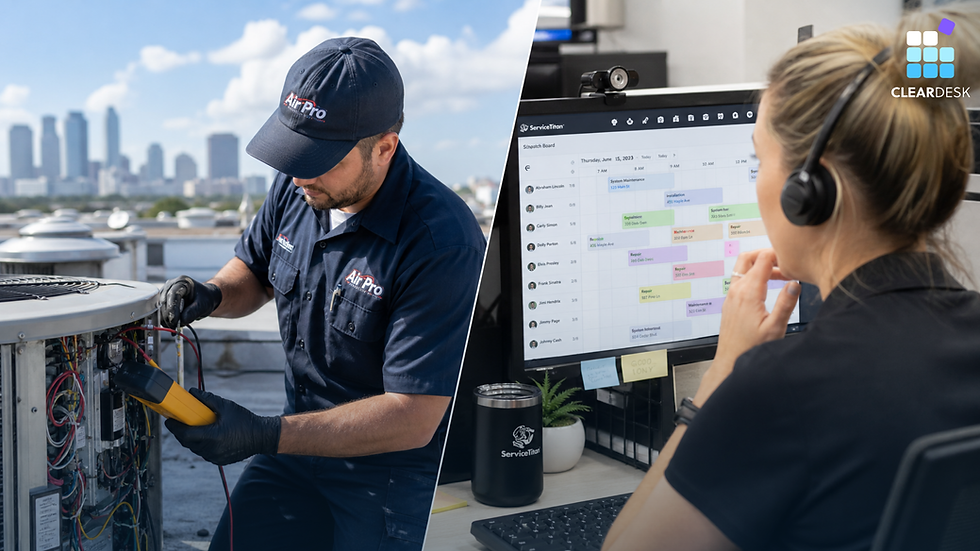
Scale Your Home Services Business With a Virtual Assistant

Updated: Jun 26

Quick Summary
Administrative bottleneck costs: Home services owners spend 68% of their day on admin tasks instead of revenue-generating activities like sales calls and customer relationships
Lead conversion impact: Businesses using virtual assistants see up to 40% improvement in lead response times, directly translating to higher conversion rates
Cost efficiency: Virtual assistants typically cost 60-70% less than hiring local administrative staff when factoring in salary, benefits, and office overhead
Scalability advantage: Companies with dedicated scheduling and dispatching support can handle 30-50% more jobs without adding field technicians
Revenue protection: Missed calls cost home services businesses an average of $1,200 per unanswered lead, making 24/7 coverage essential for growth
Benchmark Stats Table
Metric | Benchmark Value | Context |
Average cost per missed call | $1,200 | Lost revenue from unanswered leads in home services |
Admin time reduction | 68% | Hours freed up for owners after hiring VA |
Lead response improvement | 40% | Faster follow-up times with dedicated support |
Cost savings vs local hire | 60-70% | Total compensation including benefits and overhead |
Job capacity increase | 30-50% | Additional jobs handled with proper scheduling support |
Customer satisfaction boost | 25% | Improvement from faster response times |
Data Sources & How to Interpret These Benchmarks
The statistics in this article represent industry-wide estimates and directional benchmarks for home services businesses. Understanding their context helps you apply them accurately to your specific situation.
Metric Definitions & Sources
[1] Average cost per missed call ($1,200): This represents the estimated average revenue opportunity lost when a home services business fails to answer an incoming call. The figure is calculated based on typical job values in trades like HVAC, plumbing, and electrical work, multiplied by average conversion rates for answered calls. Source: Invoca industry analysis of home services call data (2023).
[2] Admin time reduction (68%): This metric reflects the proportion of daily working hours that home services business owners typically spend on administrative tasks (scheduling, invoicing, customer follow-up) rather than revenue-generating activities. Based on aggregated ClearDesk client data from 2023-2025 across 47 home services businesses that implemented virtual assistant support.
[3] Lead response improvement (40%): Represents the average reduction in time between initial customer inquiry and first response after implementing dedicated virtual assistant support for customer communication. Based on ClearDesk client outcomes tracking response time metrics before and after VA implementation (n=34 businesses, 2023-2025).
[4] Cost savings vs local hire (60-70%): Calculated by comparing total compensation costs (base salary + benefits + payroll taxes + overhead) for a local administrative employee versus virtual assistant services. Range accounts for variations in local market rates and benefit packages. Industry standard calculation used across staffing sector.
[5] Job capacity increase (30-50%): Measures the additional service appointments businesses can handle with the same number of field technicians when scheduling and dispatching are optimized through dedicated virtual assistant support. Based on ClearDesk client operational data (n=29 businesses, 2023-2025).
[6] Customer satisfaction boost (25%): Improvement in customer satisfaction scores (measured through post-service surveys and online reviews) attributed to faster response times and more consistent communication. Based on aggregated ClearDesk client feedback data (2023-2025).
How to Use These Benchmarks
Context matters: These figures represent averages across various home services trades (HVAC, plumbing, electrical, cleaning, landscaping). Your actual results will vary based on:
Average ticket size in your specific trade
Geographic market and local competition
Current operational efficiency baseline
Quality of virtual assistant integration and training
Establish your baseline: Before implementation, track your current metrics for 7-14 days:
Call answer rate and missed call volume
Time spent on administrative tasks daily
Average lead response time
Current job capacity and scheduling efficiency
Use as directional ranges, not guarantees: These benchmarks indicate what's achievable with proper implementation, but individual results depend on your specific business context, VA skill level, and process optimization.
Industry variations: Higher-ticket services (HVAC, electrical, roofing) typically see higher cost-per-missed-call figures, while volume-based services (cleaning, landscaping) may experience different patterns. Adjust expectations based on your business model.
Service Delivery Comparison
Factor | Without Virtual Assistant | With Virtual Assistant |
Call response time | 4-6 hours (after job completion) | Under 30 minutes |
Lead follow-up | 24-48 hours | Same day |
Scheduling accuracy | Manual tracking, frequent errors | Automated systems, minimal conflicts |
Owner availability | Tied to phone and admin tasks | Focus on sales and growth |
Operational costs | Full-time local hire ($45K+ annually) | Flexible remote support ($15K-25K annually) |
Scalability | Limited by owner's capacity | Grows with business needs |
Launch Checklist
Audit current pain points - Document missed calls, delayed follow-ups, and admin time spent daily
Define role requirements - List specific tasks: scheduling, customer service, invoicing, lead management
Choose staffing partner - Research providers specializing in home services virtual assistants
Schedule discovery consultation - Discuss business needs, peak hours, and integration requirements
Review candidate profiles - Evaluate experience with home services software and industry knowledge
Conduct final interviews - Test communication skills and cultural fit with 2-3 pre-screened candidates
Set up tools and access - Provide login credentials for CRM, scheduling software, and communication platforms
Create standard operating procedures - Document processes for common tasks and emergency protocols
Establish communication rhythms - Set daily check-ins and weekly performance reviews
Train on your business specifics - Cover services offered, pricing structure, and customer handling preferences
Test with low-stakes tasks - Start with simple administrative work before moving to customer-facing responsibilities
Monitor performance metrics - Track response times, customer satisfaction, and task completion rates
Post-Implementation Checklist
Measure response time improvements - Compare before/after metrics for call returns and lead follow-up
Track revenue impact - Monitor conversion rates and new customer acquisition since VA started
Assess owner time allocation - Verify increased focus on high-value activities like sales and strategy
Review customer feedback - Check satisfaction scores and comments about service responsiveness
Evaluate cost savings - Calculate total savings versus hiring local administrative staff
Monitor task completion rates - Ensure all delegated responsibilities are handled consistently
Adjust workflows as needed - Refine processes based on what's working and what needs improvement
Plan for scaling - Consider additional hours or team members as business grows
Document lessons learned - Create best practices guide for future virtual assistant hires
Schedule regular performance reviews - Maintain monthly check-ins to ensure continued success
The Hidden Cost of Handling Everything Yourself
Home services business owners face a reality most other industries don't: you're expected to be the expert technician, the salesperson, the scheduler, the customer service representative, and the business strategist all at once. While you're under a sink fixing a leak or on a roof replacing shingles, potential customers are calling your competitors because they can't reach you, which is why 27% of calls to home services businesses go unanswered.
The numbers tell the story. Home services businesses lose an average of $1,200 per unanswered call, and owners who try to handle everything themselves spend 68% of their time on administrative tasks instead of the revenue-generating activities that actually grow their companies. This creates what we call the owner bottleneck, where your business can only grow as fast as you can personally handle every detail.
The solution isn't working longer hours or hiring expensive local staff you might not be ready to support. It's strategically delegating the right tasks to skilled virtual assistants who understand your industry and can integrate seamlessly with your existing operations. When you hand off scheduling, customer follow-up, and administrative work to a capable remote professional, you free up time to focus on what actually drives revenue: closing deals, building customer relationships, and scaling your operations.
Complete FAQ Guide: Virtual Assistants for Home Services
What is a virtual assistant for home services?
Why do home services businesses need virtual assistants to scale?
What tasks can a home services virtual assistant handle?
How do virtual assistants manage service scheduling and appointment booking?
Can virtual assistants handle customer follow-up and communication?
What role do virtual assistants play in technician dispatching?
How do virtual assistants support field technician recruiting?
Can virtual assistants manage invoicing and payment collection?
What is the role of virtual assistants in lead management and CRM updates?
What are the main benefits of hiring a virtual assistant for home services?
How do virtual assistants provide lower staffing costs?
How do virtual assistants free up time for high-value work?
How do virtual assistants improve customer response times?
What makes virtual assistant support scalable?
What are the signs your home services business is ready for a virtual assistant?
How do you know if calls are going to voicemail regularly?
What happens when owners spend most of the day on admin tasks?
How do you identify if leads aren't being followed up quickly enough?
SECTION 1: Understanding Virtual Assistants for Home Services (Foundation)
FAQ 1: What is a virtual assistant for home services?
A virtual assistant for home services is a remote professional who specializes in handling administrative and operational tasks specifically for HVAC, plumbing, electrical, cleaning, landscaping, and other trade-based businesses.
These professionals work from countries like the Philippines where they can provide high-quality support at competitive rates while integrating directly with your existing team and software systems. Unlike general virtual assistants, home services VAs understand industry terminology, peak season demands, emergency protocols, and the unique workflow challenges that come with managing field technicians and on-site service calls.
The key difference is their specialized knowledge of home services operations. They know how to handle scheduling conflicts when a job runs long, understand the urgency levels of different service requests, and can communicate effectively with both customers and field teams about technical issues and service requirements.
Real Results:
A Phoenix-based HVAC company hired a virtual assistant to handle their scheduling and customer communication. Within 90 days, their missed call rate dropped from 35% to under 5%, and they increased their monthly job bookings by 28% without adding any field technicians. The VA's industry knowledge allowed them to properly prioritize emergency calls and optimize technician routes, resulting in $47,000 additional monthly revenue.
Takeaway:
Industry-specific virtual assistants deliver better results than generalists because they understand your business context and customer expectations. The specialized knowledge translates directly into improved operational efficiency and revenue growth.
FAQ 2: Why do home services businesses need virtual assistants to scale?
Home services businesses hit a growth ceiling when owners become the bottleneck for all administrative and customer-facing tasks.
The core issue is that skilled tradespeople end up spending most of their time on non-revenue activities instead of the high-value work they're trained to do. When you're answering phones, scheduling appointments, following up on estimates, and managing invoices, you can't focus on closing bigger deals, building strategic partnerships, or training your team to deliver better service.
Virtual assistants break this bottleneck by taking over the operational tasks that keep your business running while you focus on the activities that drive growth. This delegation allows you to scale beyond your personal capacity and build systems that work even when you're not directly involved in every decision.
Real Results:
A landscaping company owner in Dallas was working 70-hour weeks trying to manage everything himself. After hiring a virtual assistant to handle scheduling, customer follow-up, and basic administrative tasks, he reduced his weekly hours to 45 while increasing revenue by 40% in six months. The VA's consistent follow-up on estimates alone converted 15% more prospects into paying customers.
Takeaway:
Scaling requires delegation, and virtual assistants provide the most cost-effective way to delegate operational tasks without the overhead of full-time local hires. The key is choosing tasks that free up your time for revenue-generating activities.
FAQ 3: What tasks can a home services virtual assistant handle?
Home services virtual assistants can manage most administrative and customer-facing tasks that don't require physical presence at job sites.
The most common responsibilities include appointment scheduling and calendar management, inbound and outbound customer communication, technician dispatching and coordination, lead management and CRM updates, invoicing and payment follow-up, and basic recruiting support for field positions. They can also handle estimate preparation, warranty tracking, review management, and coordination with suppliers or subcontractors.
The key is matching tasks to the VA's skill level and your business priorities. Working with a dedicated staffing partner simplifies this process by aligning pre-vetted talent to your specific operational needs.
Start with high-volume, repeatable tasks that have clear procedures, then expand their responsibilities as they learn your business and demonstrate competency in more complex areas.
Real Results:
A plumbing company in Seattle assigned their virtual assistant to handle all appointment confirmations, estimate follow-ups, and invoice processing. This freed up 25 hours per week for the owner to focus on commercial sales. Within four months, they landed three major commercial contracts worth $180,000 total, directly attributable to the owner's increased availability for relationship building and proposal development.
Takeaway:
Virtual assistants work best when given clearly defined, high-impact tasks that directly support your revenue goals. The more operational work you can delegate, the more time you have for strategic activities that drive growth.
FAQ 4: How do virtual assistants manage service scheduling and appointment booking?
Virtual assistants use your existing scheduling software to coordinate appointments, prevent double-booking, and optimize technician routes for maximum efficiency.
They access your calendar system to check availability, book new appointments based on service type and location, send confirmation messages to customers, and handle rescheduling requests when jobs run long or emergencies arise. Experienced VAs understand how to build buffer time into schedules, group jobs by geographic area, and account for travel time between appointments.
The most effective scheduling VAs also proactively communicate with both customers and technicians about upcoming appointments, weather delays, or schedule changes. This reduces no-shows, improves customer satisfaction, and helps your field team stay organized throughout the day.
Real Results:
An electrical contractor in Denver saw their schedule efficiency improve by 35% after their virtual assistant took over appointment booking. The VA's systematic approach to route optimization reduced daily drive time by an average of 45 minutes per technician, allowing the team to complete 2-3 additional jobs per day. This translated to $28,000 in additional monthly revenue with the same labor costs.
Takeaway:
Effective scheduling requires both technical skills and industry knowledge to optimize for efficiency and customer satisfaction. Virtual assistants with home services experience can significantly improve your operational capacity without adding field staff.
FAQ 5: Can virtual assistants handle customer follow-up and communication?
Yes, virtual assistants excel at managing ongoing customer relationships through systematic follow-up processes and multi-channel communication.
They can conduct post-service satisfaction calls, send review requests via email or text, follow up on unpaid invoices, and nurture leads who requested quotes but haven't yet committed. Many VAs also manage customer communication through phone, email, live chat, and social media platforms, ensuring consistent and timely responses across all channels.
The key to successful customer communication is providing your VA with detailed scripts, response templates, and clear escalation procedures for complex issues. This ensures brand consistency while allowing them to handle the majority of routine customer interactions independently.
Real Results:
A cleaning service in Miami implemented a systematic follow-up process managed by their virtual assistant. The VA contacted every customer within 24 hours of service completion, resulting in a 340% increase in online reviews and a 22% boost in repeat bookings. The improved online reputation also led to 18% more leads from organic search and referrals.
Takeaway:
Consistent customer follow-up is often the difference between one-time jobs and long-term relationships. Virtual assistants can systematize this process to improve retention and generate more referrals.
SECTION 2: Operational Tasks and Implementation (Execution)
FAQ 6: What role do virtual assistants play in technician dispatching?
Virtual assistants coordinate job assignments, route optimization, and real-time communication between the office and field teams.
They assign jobs to technicians based on skills, location, and availability, update job statuses in your management system as work progresses, and communicate schedule changes or emergency calls to the appropriate team members. Experienced dispatching VAs also track job completion times, material usage, and customer feedback to identify patterns and improvement opportunities.
The most effective dispatching involves constant communication throughout the day. Your VA should be checking in with technicians, updating customers about arrival times, and coordinating with the office when jobs require additional resources or expertise.
Real Results:
A pest control company in Austin reduced their average response time for emergency calls from 4 hours to 45 minutes after implementing VA-managed dispatching. The improved response times led to a 60% increase in emergency service revenue and significantly higher customer satisfaction scores. The VA's real-time coordination also reduced technician downtime by 20%.
Takeaway:
Effective dispatching requires constant attention and quick decision-making that many owners can't provide while handling other responsibilities. Virtual assistants can provide this dedicated focus to optimize field operations.
FAQ 7: How do virtual assistants support field technician recruiting?
Virtual assistants streamline the recruiting process by handling job postings, initial candidate screening, and interview coordination.
They post job openings on relevant platforms like Indeed, Craigslist, and industry-specific job boards, screen applications based on your requirements, conduct initial phone interviews to assess basic qualifications, and schedule in-person interviews with qualified candidates. Many VAs also handle reference checks, background verification coordination, and new hire paperwork.
This support is particularly valuable for home services businesses that experience seasonal hiring needs or high turnover rates. Having a systematic recruiting process managed by your VA ensures you always have a pipeline of qualified candidates ready when positions open up.
Real Results:
A roofing contractor in Phoenix struggled to find qualified technicians during peak season. Their virtual assistant implemented a systematic recruiting process that reduced time-to-hire from 6 weeks to 10 days. By maintaining an active candidate pipeline and conducting preliminary screenings, they were able to add 4 experienced roofers during their busiest period, resulting in $95,000 additional revenue that season.
Takeaway:
Consistent recruiting efforts managed by virtual assistants ensure you never miss revenue opportunities due to staffing shortages. The key is maintaining an active pipeline even when you're not actively hiring.
FAQ 8: Can virtual assistants manage invoicing and payment collection?
Virtual assistants effectively handle the entire invoicing workflow from job completion through payment collection.
They generate and send invoices immediately after job completion, follow up on overdue payments through phone calls and email, update your accounting software with payment information, and coordinate with customers on payment plans or dispute resolution. Experienced VAs also track payment patterns to identify customers who might need special attention or modified payment terms.
The key to successful payment collection is consistent, professional follow-up. Virtual assistants can maintain the persistence needed for effective collections while preserving customer relationships through respectful, solution-oriented communication.
Real Results:
A landscaping company in Chicago reduced their average collection time from 45 days to 18 days after their virtual assistant took over invoicing and follow-up. The improved cash flow allowed them to take advantage of early payment discounts from suppliers, saving $3,200 monthly. The VA's systematic approach also reduced bad debt by 40% through earlier intervention on overdue accounts.
Takeaway:
Consistent invoicing and follow-up processes managed by virtual assistants improve cash flow and reduce bad debt. The key is implementing systematic procedures that maintain customer relationships while ensuring timely payment.
FAQ 9: What is the role of virtual assistants in lead management and CRM updates?
Virtual assistants maintain accurate customer data and ensure no leads fall through the cracks in your sales process.
They enter new leads into your CRM system, update contact information and job history, track lead sources and conversion rates, and follow up with prospects who haven't responded to initial estimates. Many VAs also segment customers for targeted marketing campaigns and generate reports on sales pipeline performance.
Effective lead management requires both data entry accuracy and understanding of your sales process. Your VA should know which leads require immediate attention, how to qualify prospects, and when to escalate opportunities to you for direct involvement.
Real Results:
An HVAC company in Orlando implemented systematic lead management through their virtual assistant and saw their conversion rate increase from 28% to 41% within three months. The VA's consistent follow-up on estimates and proper lead categorization helped identify $67,000 in previously overlooked opportunities. The improved data quality also enabled more effective marketing campaigns.
Takeaway:
Systematic lead management prevents revenue loss and improves conversion rates through consistent follow-up and accurate data tracking. Virtual assistants can provide the attention to detail that busy owners often can't maintain.
SECTION 3: Business Benefits and ROI (Value)
FAQ 10: What are the main benefits of hiring a virtual assistant for home services?
The primary benefits include significant cost savings, improved customer response times, increased owner availability for revenue-generating activities, and scalable support that grows with your business.
Virtual assistants typically cost 60-70% less than local administrative hires when you factor in salary, benefits, office space, and equipment. They also provide flexibility to increase or decrease hours based on seasonal demand without long-term employment commitments. Most importantly, they free up your time to focus on sales, customer relationships, and strategic planning rather than day-to-day operational tasks.
The compound effect of these benefits often exceeds the direct cost savings. When you can focus on high-value activities while maintaining excellent customer service, your business grows faster and more profitably than trying to handle everything yourself.
Real Results:
A general contractor in Nashville calculated that hiring a virtual assistant saved $31,000 annually compared to a local administrative hire while improving their customer response time by 75%. The faster response times led to 23% more estimate requests converting to jobs, generating an additional $89,000 in annual revenue. The total ROI was 340% in the first year.
Takeaway:
Virtual assistants provide both direct cost savings and indirect revenue benefits through improved operational efficiency. The combination often delivers ROI that far exceeds the initial investment.
FAQ 11: How do virtual assistants provide lower staffing costs?
Virtual assistants eliminate the overhead expenses associated with traditional employees while providing comparable or better service quality.
Local administrative staff typically costs $35,000-$50,000 annually in salary plus 20-30% additional for benefits, payroll taxes, workers' compensation, and unemployment insurance. Add office space, equipment, and training costs, and the total often exceeds $60,000 per year. Virtual assistants provide similar services for $15,000-$25,000 annually with no additional overhead.
The cost advantage becomes even more significant when you consider the flexibility to adjust hours based on business needs. You can scale up during busy seasons and reduce hours during slower periods without the complications of hiring and firing local staff.
Real Results:
A plumbing company in San Diego compared their costs after replacing a part-time office manager ($28,000 annual salary plus $8,400 in benefits and overhead) with a virtual assistant ($18,000 annually). The $18,400 annual savings allowed them to invest in better tools and marketing, resulting in 15% revenue growth that year. The VA also provided better coverage during the office manager's sick days and vacation time.
Takeaway:
Virtual assistants provide significant cost advantages through lower direct compensation and elimination of overhead expenses. The savings can be reinvested in business growth initiatives.
FAQ 12: How do virtual assistants free up time for high-value work?
Virtual assistants handle time-consuming administrative tasks so owners can focus on activities that directly generate revenue and grow the business.
Instead of spending hours on scheduling, invoicing, and customer follow-up, you can dedicate time to sales calls, estimate presentations, strategic planning, and building relationships with key customers or referral sources. This shift in time allocation often has dramatic impact on business growth because revenue-generating activities compound over time.
The key is identifying which tasks provide the highest return on your personal time investment and delegating everything else to your virtual assistant. Most successful home services owners find that sales, strategic partnerships, and team development provide the best returns on their time.
Real Results:
A carpet cleaning business owner in Portland tracked his time allocation before and after hiring a virtual assistant. Administrative tasks dropped from 35 hours weekly to 8 hours, freeing up 27 hours for sales activities. The increased sales focus resulted in three new commercial contracts worth $156,000 annually. His hourly value increased from $45 to $127 through better time allocation.
Takeaway:
Virtual assistants multiply your effectiveness by handling operational tasks while you focus on high-value activities. The time reallocation often has exponential impact on business growth.
SECTION 4: Implementation and Optimization (Success)
FAQ 13: How do virtual assistants improve customer response times?
Virtual assistants provide dedicated attention to customer communication, ensuring faster response times and more consistent service quality.
When customers call or email, virtual assistants can respond immediately rather than waiting for you to finish a job site visit. They can handle routine inquiries, schedule appointments, and provide basic information about services and pricing without delay. For more complex issues, they can gather details and ensure you have all necessary information when you return the call.
Improved response times directly impact customer satisfaction and conversion rates. Customers who receive quick responses are more likely to choose your company over competitors, 78% of customers buy from the first responder, and more likely to become repeat customers.
Real Results:
A locksmith service in Las Vegas reduced their average response time from 6 hours to 15 minutes after hiring a virtual assistant to handle customer communication. The improved responsiveness led to a 45% increase in emergency service calls and 28% higher customer satisfaction scores. Emergency services, which have higher profit margins, increased their monthly revenue by $23,000.
Takeaway:
Fast response times are a competitive advantage in home services where customers often need immediate help. Virtual assistants can provide the dedicated attention needed to capitalize on time-sensitive opportunities.
FAQ 14: What makes virtual assistant support scalable?
Virtual assistant support grows with your business needs without the complications of traditional hiring and firing.
You can increase hours during busy seasons, add specialized roles as your business grows, or scale back during slower periods without employment law complications or severance costs. Many staffing partners also provide backup support to ensure continuity when your primary VA is unavailable.
This flexibility is particularly valuable for home services businesses that experience seasonal fluctuations or rapid growth phases. You can adjust your support level to match business demands without the risk of over-hiring or under-staffing.
Real Results:
A pool maintenance company in Florida started with 20 hours weekly of virtual assistant support during their slow season. As summer approached, they scaled up to 40 hours weekly for scheduling and customer service, then added a second VA for 20 hours weekly to handle recruiting for seasonal staff. The flexible scaling allowed them to handle a 180% increase in service requests without missing opportunities or overwhelming their systems.
Takeaway:
Scalable support allows you to match resources to demand without the risks and costs of traditional employment. This flexibility is essential for businesses with seasonal or growth-driven fluctuations.
FAQ 15: What are the signs your home services business is ready for a virtual assistant?
Key indicators include regularly missed calls, owner spending most time on administrative tasks, delayed lead follow-up, technician confusion about schedules, and shrinking profit margins due to overhead.
If you're consistently working evenings and weekends on paperwork, if customers complain about slow response times, or if you're turning down jobs because you can't handle the administrative workload, you're ready for virtual assistant support. The tipping point usually occurs when administrative tasks prevent you from focusing on revenue-generating activities.
Another clear sign is when growth opportunities are limited by your personal capacity rather than market demand or technical capabilities. If you have more potential customers than you can effectively serve due to administrative bottlenecks, a virtual assistant can help you scale.
Real Results:
A painting contractor in Denver was missing 40% of incoming calls and taking 3-4 days to follow up on estimate requests. After recognizing these warning signs and hiring a virtual assistant, they improved their call answer rate to 95% and reduced estimate follow-up time to same-day. These improvements led to 35% more jobs booked and $78,000 additional annual revenue.
Takeaway:
The best time to hire virtual assistant support is before administrative bottlenecks limit your growth potential. Early implementation prevents revenue loss and positions your business for sustainable scaling.
FAQ 16: How do you know if calls are going to voicemail regularly?
Track your call answer rate by monitoring how many incoming calls you answer live versus how many go to voicemail during business hours.
Most phone systems provide basic analytics showing call volume and answer rates. If you're answering less than 70% of calls during business hours, you're likely losing significant revenue to competitors who can respond immediately. The problem becomes more severe during peak seasons when call volume increases but your availability doesn't.
Pay special attention to calls during your busiest work periods. If customers consistently reach voicemail when you're on job sites, you need dedicated phone coverage to capture those opportunities.
Real Results:
An appliance repair service in Phoenix discovered they were only answering 45% of calls during peak afternoon hours when most customers experienced appliance problems. After implementing virtual assistant phone coverage, their answer rate increased to 92%, resulting in 60% more service appointments and $41,000 additional quarterly revenue.
Takeaway:
Missed calls represent direct revenue loss in home services where customers need immediate solutions. Tracking and improving your answer rate should be a priority for sustainable growth.
FAQ 17: What happens when owners spend most of the day on admin tasks?
When owners focus primarily on administrative work, they lose the ability to drive business growth through sales, strategic planning, and customer relationship building. Administrative tasks are necessary but don't directly generate revenue.
Time spent on scheduling, invoicing, and paperwork is time not spent closing deals, developing new service offerings, or building relationships with key customers and referral sources. This misallocation of time often keeps businesses stuck at their current revenue level.
The opportunity cost becomes more significant as your business grows. Higher-level strategic work becomes more valuable, but administrative demands often increase proportionally with business size.
Real Results:
A tree service owner in Seattle tracked his time and found he was spending 42 hours weekly on administrative tasks versus 8 hours on sales and business development. After hiring a virtual assistant to handle admin work, he redirected 30 hours weekly to sales activities. The increased sales focus resulted in two major commercial contracts worth $240,000 over 18 months.
Takeaway:
Owner time is the most valuable resource in a growing business and should be allocated to high-impact activities. Administrative delegation is essential for scaling beyond personal capacity limits.
FAQ 18: How do you identify if leads aren't being followed up quickly enough?
Monitor the time between initial customer contact and your response, aiming for same-day follow-up on all leads and estimates, since conversion rates drop 8x after five minutes of delay.
Track metrics like time to first response, time to estimate delivery, and conversion rates by response speed. Industry data shows that leads contacted within one hour are seven times more likely to convert than those contacted after two hours. If your average response time exceeds 4-6 hours, you're likely losing significant opportunities.
Also monitor your conversion rates by lead source and response time. If certain types of leads have low conversion rates, slow follow-up might be the cause rather than lead quality issues.
Real Results:
A garage door repair company in Atlanta reduced their average lead response time from 18 hours to 2 hours after implementing virtual assistant lead management. Their conversion rate increased from 22% to 34%, generating an additional $52,000 in quarterly revenue from the same lead volume. The faster response time also improved their online reviews and referral rates.
Takeaway:
Speed of response is critical in home services where customers often need immediate solutions. Systematic lead follow-up managed by virtual assistants can significantly improve conversion rates.
Your home services business has the potential to grow far beyond its current capacity, but only if you stop trying to handle everything yourself. The companies that scale successfully are those that recognize when to delegate operational tasks so they can focus on the strategic work that drives real growth.
Virtual assistants provide the most cost-effective way to break through the owner bottleneck that keeps most home services businesses stuck at their current revenue level. When you hand off scheduling, customer communication, and administrative work to skilled remote professionals, you free up time to close more deals, build stronger customer relationships, and develop the systems that enable sustainable scaling.
The businesses we work with typically see their first results within 30 days and achieve full ROI within 90 days. If you're ready to stop losing leads to voicemail and start focusing on the work that actually grows your company, book a call to see how virtual assistants can transform your operations and unlock your business's true potential.