
How to Hire a Remote Team Member for Recruiting

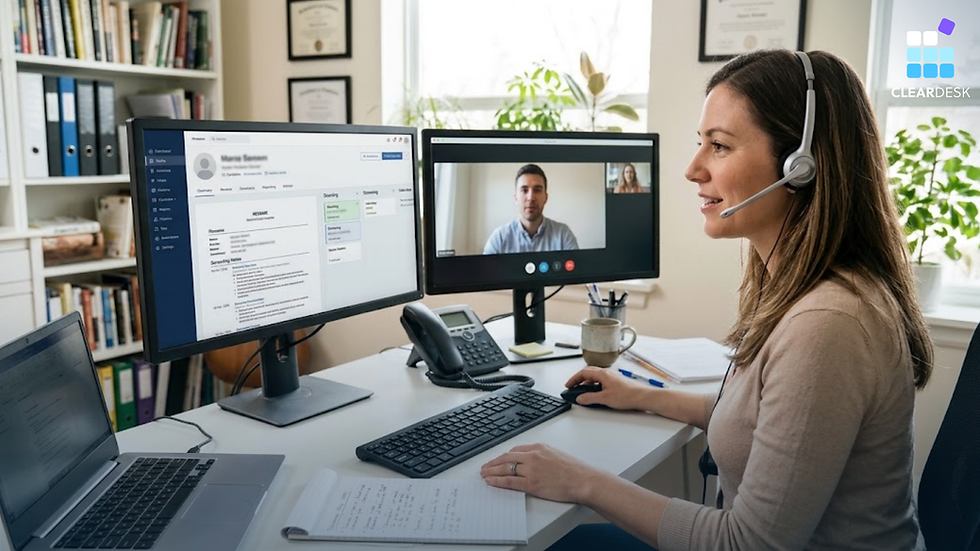
A remote team member for recruiting is a professional who handles talent acquisition tasks from a remote location, often offshore. They source candidates, screen resumes, schedule interviews, and manage your applicant pipeline, all without sitting in your office. If your team is stretched thin on hiring, or you're paying too much for local recruiting help, a remote recruiter is worth a serious look.
What Is a Remote Team Member for Recruiting?
A remote recruiter does the same core work as an in-house recruiter, but from a different location, often in a different time zone. They are not a job board or an AI tool. They are a real person who works your hiring process every day.
Here's what a remote team member for recruiting typically handles:
Candidate sourcing: Finding qualified applicants through job boards, LinkedIn, referrals, and direct outreach
Resume screening: Reviewing applications against your job requirements and filtering out poor fits
Interview coordination: Scheduling and conducting initial candidate calls on your behalf
Pipeline management: Tracking every applicant through your hiring stages inside an ATS (applicant tracking system)
The key difference from a traditional in-house recruiter is cost and flexibility. A U.S.-based recruiter comes with a full salary, benefits, and overhead. A remote recruiter, especially one placed through a staffing partner, gives you the same output at a much lower monthly cost.

How to Source Qualified Remote Recruiters
There are three main channels for finding remote recruiting talent. Each has trade-offs.
Remote Job Boards and Talent Platforms
Platforms like LinkedIn, Indeed Remote, We Work Remotely, and FlexJobs all let you post remote roles and search candidate profiles. This approach gives you direct access to a large pool of applicants, but it puts the full burden of screening on you.
You'll get volume. Whether you get quality depends entirely on how well you define the role and how much time you spend reviewing applications.
Employee Referrals and Networks
Referrals from existing team members or industry contacts often produce stronger candidates than cold job postings. If you're already connected to professional recruiting communities or HR networks, ask around.
Referrals tend to come pre-screened by trust. Someone in your network has already worked with the person and can speak to their reliability and output.
Staffing and Outsourcing Partners
This is the fastest path to a qualified remote recruiter, and it carries the least hiring risk. A staffing company that specializes in remote placement does the sourcing, screening, and vetting before you ever see a candidate.
At ClearDesk, we process more than 55,000 applications per quarter and accept less than 0.5% of applicants. By the time a candidate reaches you for an interview, they've already passed multiple rounds of assessment. That's a very different experience from sorting through 200 resumes on Indeed.
How to Evaluate Remote Recruiting Candidates
Evaluating a remote recruiter is different from hiring an in-house one. You can't observe how they work day to day, so you need to assess the right traits before you make an offer.
Communication and Language Proficiency
Your remote recruiter will represent your company to every candidate they contact. Their written and verbal English must be clear, professional, and easy to understand.
Look for candidates who write in complete sentences, respond promptly, and communicate without ambiguity. Vague or slow communicators will create problems in your hiring pipeline.
Reliability and Self-Management
Remote work requires discipline. Without someone looking over their shoulder, a remote recruiter needs to manage their own schedule, meet deadlines, and stay accountable to outcomes.
Ask for specific examples of how they've managed competing priorities without direct supervision. Strong candidates will describe systems and habits, not just intentions.
Cultural Fit and Work Ethic
Your remote recruiter will speak to candidates about your company, your values, and what it's like to work for you. If they don't understand your culture, they'll misrepresent it.
Look for candidates who ask good questions about your business during the interview. That curiosity signals they care about fit, not just filling a role.
Recruiting Experience and Industry Knowledge
A recruiter with experience in your industry will get up to speed faster and source better candidates. This matters especially in specialized fields like home care, where understanding caregiver roles, HHAeXchange workflows, and EVV compliance affects who gets sourced and how.
If you run a home care agency, a remote recruiter who already understands the caregiver hiring cycle, AxisCare or ClearCare integrations, and HIPAA-compliant communication practices will produce results much faster than a generalist.
Brenda K. Rubalcaba, Client Care Manager and HR Manager at Synergy Homecare, put it well: "She has been amazing with recruiting, communicating with the caregivers and applicants. There is not a task that she has been given that she has not completed."
That kind of reliability starts at the evaluation stage. You find it by asking the right questions and testing for real-world skills before you hire.
How to Interview a Remote Recruiter
The interview process for a remote team member should mirror the way they'll actually work. Here's the process we recommend.
1. Conduct Video Interviews to Assess Communication
A video call tells you a lot. You'll see how the candidate presents themselves on camera, how clearly they speak, and how comfortable they are with remote communication tools.
Watch for eye contact, clear audio, a professional background, and the ability to answer questions without rambling. These are the same standards your candidates will experience when this recruiter calls them.
2. Assign Asynchronous Tasks to Test Independence
Give the candidate a small sourcing assignment or written exercise before making a decision. Ask them to find five qualified candidates for a sample role, or write a job posting for a position you're currently hiring for.
This shows you how they work without real-time supervision. It also reveals their attention to detail, writing quality, and ability to follow instructions.
3. Use Scenario-Based Questions to Evaluate Problem Solving
Ask questions like: "How would you handle a hiring manager who keeps rejecting candidates without clear feedback?" or "What would you do if your top candidate went silent after a verbal offer?"
Strong candidates will describe specific steps, not vague strategies. This reveals how they think under pressure and whether they can manage the messy parts of recruiting without hand-holding.
How Much Does a Remote Recruiter Cost?
Cost is one of the first questions we get on discovery calls, and it's a fair one. Here's how the options compare.
U.S.-Based Recruiter Salary Benchmarks
Domestic recruiters command higher salaries — the BLS median is $75,940 — plus benefits
expectations and overhead. When you factor in salary, health insurance, payroll taxes, and onboarding costs, the total investment is significant, especially for a small or mid-sized business.
Offshore and Virtual Recruiter Pricing
Remote recruiters from the Philippines and similar regions cost a fraction of U.S. hires, often with comparable or stronger work ethic and communication skills. When placed through a staffing partner like ClearDesk, pricing is fixed and transparent with no hidden fees.
ClearDesk placements start at $2,500 per month with no long-term contract. That structure gives you flexibility to scale up or exit without being locked in.
Comparing Costs and Calculating Savings
Hiring Option | Typical Cost Structure | Additional Fees |
U.S. full-time recruiter | Salary plus benefits and overhead | Recruiting costs, training time |
Freelance remote recruiter | Hourly or project-based | Variable quality, no ongoing support |
Staffing partner (e.g., ClearDesk) | Fixed monthly rate | Often includes vetting, training, and support |
One honest limitation worth noting: ClearDesk does not offer part-time placements or generic staffing. Our model is built around dedicated, full-time remote team members placed in specific roles. If you need someone for ten hours a week, we're not the right fit.

Common Risks When Hiring Remote Recruiters
Remote hiring has real risks. Knowing them upfront helps you avoid the most common mistakes.
Communication and Timezone Challenges
Misaligned hours can slow collaboration. If your remote recruiter is working while your team sleeps, you may not catch issues until the next day.
The fix is simple: set a defined overlap window for real-time communication. Even two to three hours of shared online time each day is enough to stay aligned.
Vetting and Quality Gaps
Hiring a remote recruiter directly without thorough screening is one of the biggest risks. A poor fit in a recruiting role doesn't just cost you time. It costs you candidates.
Use structured assessments, reference checks, and skills tests before making an offer. Or work with a staffing partner whose vetting process is already built and proven.
Retention and Turnover Issues
Remote workers leave when they feel disconnected or see no path forward. A recruiter who builds your pipeline for three months and then quits is a costly disruption.
Invest in regular check-ins, clear performance goals, and genuine recognition. Remote team members who feel like part of the team stay longer — Owl Labs reports 25% lower turnover at companies that support remote work.
Alison Kinsey-Cary, Owner of Visiting Angels, shared this after working with her ClearDesk remote recruiter: "The quality of the candidates and hires are better, with more qualifications and just a different caliber... the candidates that she has brought into the organization are more qualified and have a longer tenure."
Longer tenure from candidates often starts with a stable, engaged recruiter on your end.
How to Onboard and Manage a Remote Recruiter
A great hire can still underperform with a weak onboarding process. Here's how to set your remote recruiter up to succeed.
Set Clear Goals and Performance Expectations

Define your KPIs before day one. Common metrics include:
Candidates sourced per week
Resumes screened per day
Interviews scheduled per week
Time-to-fill for open roles, which averaged 39 days in 2026 per SHRM
Hiring manager satisfaction score
Write these down and share them in writing. A remote team member who knows exactly what success looks like will hit it faster.
Establish Communication Cadence and Check-Ins
Daily or weekly video syncs keep your remote recruiter aligned and give you visibility into their work. Use Slack or a similar tool for quick questions between meetings.
Don't wait for a weekly recap to find out something went sideways. Short, frequent check-ins prevent small issues from becoming big ones.
Provide Tools and System Access
Your remote recruiter needs the right tools from day one. Make sure they have:
ATS access (AxisCare, HHAeXchange, or your preferred platform)
A business email address
LinkedIn Recruiter or similar sourcing tool
Video conferencing setup
Access to your job posting accounts
If they're supporting a home care agency, they also need to understand your EVV system and any HIPAA-compliant communication protocols your team follows.
When to Use a Staffing Partner for Remote Recruiting
Direct hiring makes sense for some businesses. But there are clear situations where a staffing partner is the smarter choice:
You need to hire quickly and don't have time to vet candidates yourself
You want a replacement guarantee if the hire doesn't work out
You prefer ongoing support and performance management from the provider
You're hiring your first remote team member and want guidance through the process
Your internal team doesn't have recruiting expertise to evaluate recruiting candidates
Tom Margolis of Interim HealthCare described his experience this way: "We have an outstanding scheduler that has consistently outperformed most, if not all, the employees we had doing this job previously... ClearDesk handled this situation with extraordinary professionalism and care and had several excellent candidates vetted within days."
That kind of rapid response and quality is what a staffing partner with a proven process can deliver. ClearDesk provides pre-vetted remote recruiters with continued support after placement, which reduces both the risk and the effort of hiring on your own.
If you're also exploring broader support roles, our home care virtual assistant page covers how remote team members support scheduling, client communication, and operations beyond recruiting.
Ready to add a remote recruiter to your team? Book a Discovery Call and we'll walk you through exactly how the process works.
Build Your Remote Recruiting Team with Confidence
Hiring a remote team member for recruiting comes down to four things: define the role clearly, source through the right channels, evaluate with structure, and invest in onboarding.
The businesses that get this right, including home care agencies, real estate firms, and home services companies, consistently build stronger hiring pipelines at a fraction of the cost of local recruiting staff. The ones that struggle usually skipped one of those four steps.
Philip LaBrada, General Manager at Comfort Keepers, put it plainly: "Pat has already taken on recruiting tasks independently and successfully manages on-call responsibilities... ClearDesk has truly helped us increase efficiency and strengthen our operations."
That's what the right remote recruiter delivers. Not just filled roles, but a recruiting function that runs without you managing every step.
ClearDesk holds a 4.9/5 client satisfaction rating and has been recognized by Forbes for remote staffing excellence. We've built remote recruiting teams for home care agencies, real estate offices, and service-based businesses across the country.
Book a Discovery Call to see how a ClearDesk remote team member can support your recruiting needs.
Frequently Asked Questions
Q: Is hiring a remote recruiter through a staffing company legitimate?
A: Yes. Reputable staffing companies vet candidates thoroughly before placing them and provide ongoing support after the hire. The process is transparent, structured, and low-risk compared to hiring directly from a job board. ClearDesk, for example, accepts less than 0.5% of applicants and backs every placement with continued account support.
Q: How quickly can a remote recruiter start producing results?
A: A well-onboarded remote recruiter can begin sourcing candidates within the first week. Full productivity, where they're running the pipeline with minimal guidance, typically develops over the first month as they learn your process, your employer brand, and your candidate standards.
Q: What KPIs should I track for a remote recruiter?
A: The most useful metrics are candidates sourced per week, resumes screened per day, interviews scheduled, time-to-fill for open roles, and hiring manager satisfaction. Track these weekly at first, then shift to monthly reviews once your recruiter hits a consistent baseline.
Q: Can a remote recruiter handle industry-specific hiring needs?
A: Yes. Many remote recruiters have direct experience in specialized industries like home care, real estate, and home services. A staffing partner can match you with a candidate who already understands your industry, which shortens ramp time and improves candidate quality from the start.
Q: What is the difference between a remote recruiter and a virtual assistant?
A: A remote recruiter focuses specifically on talent acquisition tasks: sourcing, screening, scheduling, and pipeline management. A virtual assistant handles a broader range of administrative and operational tasks. Some businesses start with a VA who takes on recruiting duties, while others hire a dedicated recruiter for higher-volume hiring needs.
Q: Do I need to provide equipment for a remote recruiter?
A: Most remote recruiters placed through staffing partners like ClearDesk supply their own hardware and internet connection. You provide system access, such as your ATS, email, and LinkedIn Recruiter account. Your staffing partner should confirm equipment expectations before the placement begins.


