What Qualifications Do Law Virtual Assistants Need


A qualified law remote team member holds legal training, hands-on experience with law firm workflows, and knowledge of legal software. The credentials you require will depend on the tasks you plan to assign, but every legal virtual assistant should meet a clear baseline before you hand them client files or court deadlines.
We have placed remote team members with law firms across the country at ClearDesk, and the firms that struggle most are the ones that hired based on general admin skills alone. Legal work has higher stakes. A missed filing deadline or a confidentiality breach can cost a client their case and a firm its reputation.
What Is a Legal Remote Team Member
A RTM is a remote professional who handles legal and admin support tasks for attorneys and law firms without being on-site. They manage work like legal research, document drafting, court filing prep, client intake, calendar management, and case organization.
They are not attorneys and cannot give legal advice. But they can handle a large share of the work that keeps a law firm running day to day.
How a Legal Remote Team Member Differs from a General Virtual Assistant
The main difference is depth of knowledge. A general virtual assistant can manage emails and schedules. A legal RTM assistant can do those things and also prepare a motion for filing, flag a missed deadline, or draft a demand letter under attorney review.

This distinction matters because assigning legal tasks to a general assistant without legal training creates real risk. Errors in legal documents or missed procedural steps can have serious consequences for clients.
Key Qualifications for a Remote Team Member for Attorneys
This is the core of what law firms need to evaluate. Credentials fall into four main areas.
Educational Background and Legal Training
Most qualified legal virtual assistants hold one of the following:
A paralegal certificate from an accredited program
An associate or bachelor's degree in legal studies
A legal assistant certificate from a community college or online institute
Formal education is a strong signal, but it is not always required on its own. A candidate with two years of hands-on experience at a law firm may outperform someone with a certificate and no real-world exposure. Look at both together.
Legal Industry Experience
Prior work in a law firm, legal department, or court system is one of the strongest qualifiers we screen for at ClearDesk. Hands-on experience means the candidate already knows how a law firm operates, what attorneys expect, and how to handle sensitive information without being trained from scratch.
When we speak with attorneys on their first call, many tell us they have wasted time with assistants who needed months of training just to understand basic legal workflows. That cost adds up fast. Experience in a specific practice area, such as family law, personal injury, or corporate law, is even more valuable if it matches your firm's focus.
Knowledge of Legal Terms and Procedures
A qualified RTM should know these without needing to look them up:
Legal terms: Deposition, discovery, pleadings, motions, affidavits, briefs, and writs
Court procedures: Filing rules, service of process, deadlines, and jurisdiction-specific requirements
Document types: Contracts, demand letters, retainer agreements, complaints, and correspondence
If a candidate cannot explain what a motion for summary judgment is or why a statute of limitations matters, they are not ready for legal support work.
Technology and Legal Software Proficiency
A law firm remote team member should know these tools before day one:
Practice management: Clio, MyCase, PracticePanther
Document management: NetDocuments, iManage
E-filing systems: State and federal court portals
Legal research: Westlaw, LexisNexis
General tools: Microsoft Office, Adobe Acrobat, Zoom, scheduling platforms
Software proficiency is not optional. Attorneys capture only 3.0 billable hours per day on average and do not have time to teach a virtual assistant how to use Clio from scratch. We ask every candidate to walk us through how they have used these tools in past roles before they reach the interview stage.
Essential Skills Every Lawyer RTM Needs

Credentials show what someone knows. Skills show what they can do with that knowledge. Here are the five skills that separate an effective remote team member from one who creates more work than they save.
Legal Research and Writing
A qualified legal virtual assistant can search case law databases, find relevant statutes, and compile findings in a clear summary for attorney review. They can draft basic legal documents, such as demand letters or client correspondence, under attorney supervision.
This skill requires both legal knowledge and strong writing ability. If a candidate cannot write clearly and concisely, their research output will not be useful.
Document Drafting and Review
Legal documents must be exact. A strong legal virtual assistant proofreads for errors, checks formatting against court rules, and prepares documents so the attorney can review and sign without spending time on corrections.
Attention to detail is non-negotiable here. One wrong date or missing signature line can delay a filing or invalidate a document.
Client Communication and Confidentiality
Legal remote team members often serve as the first point of contact for clients. They must communicate professionally, answer questions within their scope, and know when to escalate to the attorney.
More importantly, they must understand attorney-client privilege. Every client interaction involves sensitive information, and 29% of law firms reported a breach in the past year. A legal virtual assistant who does not treat that information with care puts the firm at legal and ethical risk.
Calendar and Deadline Management

In legal work, missed deadlines are not just inconvenient. They account for 24.6% of all malpractice claims and can lead to case dismissal or sanctions. A strong legal virtual assistant tracks court dates, filing deadlines, statute of limitations dates, and attorney schedules with precision.
They should use calendar tools within your practice management software, set reminders well in advance, and flag conflicts before they become problems.
Court Filing and Case Preparation
This includes preparing documents for e-filing, organizing case files, coordinating with courts, and communicating with opposing counsel when needed. The assistant should know the filing rules for the courts your firm uses, including document format requirements and submission deadlines.
This is a task that requires credentials. Do not assign it to someone without verified legal experience.
Certifications and Training Programs for Virtual Legal Assistants
Certifications give you a verified signal that a candidate has tested legal knowledge. Here are the most recognized ones.
Paralegal Certifications
Two organizations offer widely respected paralegal credentials:
Certified Paralegal (CP) from the National Association of Legal Assistants (NALA): Requires passing a written exam covering legal research, ethics, and substantive law
Paralegal CORE Competency Exam (PCCE) from the National Federation of Paralegal Associations (NFPA): Tests core paralegal skills and knowledge
These certifications do not guarantee performance, but they confirm that a candidate has studied and passed a standardized legal knowledge test. That is a meaningful baseline.
Legal Assistant Training Programs
Many community colleges, online institutes, and legal training providers offer certificate programs for legal assistants. These programs typically cover legal terminology, document drafting, court procedures, and legal research basics.
Programs from the American Bar Association-approved schools carry more weight, but any completed program shows intentional legal training.
Legal Software Certifications
Some practice management platforms offer their own certification programs. Clio, for example, has a certification program that confirms a user can operate the platform at a professional level. These are worth requesting from candidates who list Clio or MyCase as a skill.
Continuing Education and Professional Development
The best legal remote team members do not stop learning after they earn a certificate. Court rules change, software updates, and new practice areas require new knowledge. Look for candidates who attend legal assistant webinars, take continuing education courses, or stay current with legal technology updates.
This shows professional commitment, not just baseline qualification.
Ready to find a legal remote team member who already meets these standards? Book a Discovery Call and we will walk you through exactly how we vet candidates for law firms.
How to Verify Credentials When Hiring a Remote Team Member for Attorneys
'

Verifying credentials takes time, but skipping this step is how firms end up with assistants who cannot do the work. Here is a step-by-step process for vetting legal virtual assistants.
Step 1: Review the resume for legal-specific experience. Look for law firm names, legal department roles, court system experience, or paralegal positions. General admin roles do not count.
Step 2: Check for certifications. Ask for copies of any paralegal certificates, legal assistant training completions, or software certifications. Verify the issuing organization is legitimate.
Step 3: Ask targeted interview questions. Use these during the interview:
What legal specialties have you supported, such as family law, personal injury, or corporate?
What practice management software do you use daily?
How do you handle confidential client information in a remote environment?
Walk me through how you have prepared a court filing from start to submission.
Step 4: Request references from law firm employers. A general reference from a non-legal employer does not tell you what you need to know. Ask specifically for references from attorneys or legal office managers who can speak to the candidate's legal knowledge and reliability.
Step 5: Ask for redacted work samples. A candidate with real experience can provide sample documents with client information removed. This shows you the quality of their writing and document formatting firsthand.
Step 6: Run a background check. Legal work involves access to sensitive client data. A background check is standard practice before granting access to case files or client records.
How Staffing Agencies Simplify Credential Verification
Running this process for every candidate takes hours. Most attorneys do not have that time, which is why choosing the right outsourcing provider matters.
At ClearDesk, we process over 55,000 applications per quarter and accept fewer than 0.5% of candidates. Every legal virtual assistant we place has already passed skills testing, background screening, and a structured interview process before they reach your inbox. Our 4.9/5 client satisfaction rating reflects what happens when the vetting work is done before placement, not after.
Tom Margolis from Interim HealthCare described it this way: "We have an outstanding scheduler that has consistently outperformed most, if not all, the employees we had doing this job previously. ClearDesk handled this situation with extraordinary professionalism and care and had several excellent candidates vetted within days."
Working with a staffing partner who specializes in legal or professional services vetting removes the guesswork and protects your firm from a costly mis-hire.
Tasks That Require Specialized Legal Credentials
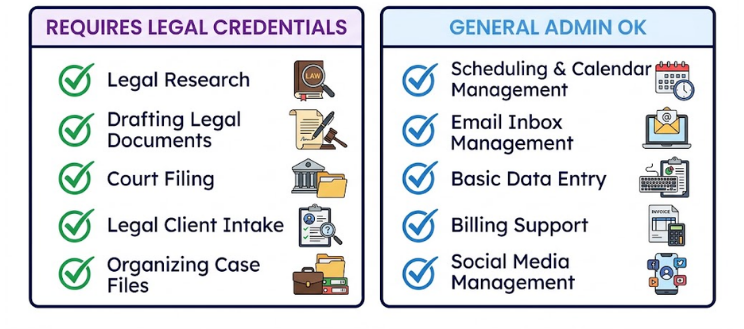
Not every task a legal remote team member handles requires a paralegal certificate. But some tasks should only go to someone with verified legal training.
Requires legal credentials or verified legal experience:
Legal research using Westlaw or LexisNexis
Drafting legal documents, motions, or correspondence
Court filing preparation and e-filing submission
Client intake involving case details or legal matters
Case file organization with privileged information
General admin tasks** any trained assistant can handle:**
Scheduling and calendar management
Email inbox management
Basic data entry and CRM updates
Billing support and invoice tracking
Social media management for the firm
Mixing these up is a common mistake. Assigning a document drafting task to someone without legal training is not just inefficient, it can create liability.
What to Look for When Hiring a Lawyer Remote Team Member
When you are ready to hire, use this checklist to evaluate candidates:
Verified legal training: A paralegal certificate, legal studies degree, or completed legal assistant program
Relevant experience: Prior work at a law firm, legal department, or court system
Technology proficiency: Hands-on experience with Clio, MyCase, PracticePanther, or similar platforms
Strong written communication: Clear, professional writing with attention to legal formatting
Confidentiality awareness: Understanding of attorney-client privilege and data security in a remote work environment
Practice area match: Experience in the same area of law your firm practices, such as immigration, family law, or litigation
References from legal employers: At least one reference who can speak to their legal knowledge specifically
One honest note: if you need someone for fewer than 20 hours per week, a dedicated legal virtual assistant placement may not be the right fit. ClearDesk places full-time dedicated team members, not part-time or project-based support. That structure works well for firms with consistent, ongoing legal support needs.
How to Find Qualified Legal Remote Team Member for Your Law Firm
You have three main options for sourcing a legal virtual assistant.
Direct hiring through job boards like Indeed or LinkedIn gives you control but requires you to run the full vetting process yourself. You will sift through many unqualified applicants before finding someone with real legal experience.
Freelance platforms like Upwork offer access to candidates who list legal skills, but verification is limited. You are largely taking their word for their credentials and experience. Comparing top virtual assistant companies with dedicated vetting processes gives you a clearer picture of what structured providers offer.
Specialized staffing agencies do the sourcing, screening, and vetting before you ever see a candidate. For firms ready to outsource their legal assistant role, this is the most reliable path because legal work has a low tolerance for hiring mistakes.
If you want to explore what a dedicated legal virtual assistant can do for your firm, our home care virtual assistant page shows how we apply the same vetting standards across specialized industries. The process translates directly to legal staffing.
ClearDesk has been recognized in Forbes for remote staffing excellence, and we bring that same standard to every legal placement. Our team takes the time to understand your practice area, your workflow, and your expectations before presenting a single candidate.
Book a Discovery Call to see how we match law firms with verified legal virtual assistants who are ready to contribute from day one.
Frequently Asked Questions
Q: Can a legal remote team member work for a law firm without a law degree?
A: Yes. Legal assistants and virtual legal assistants do not need a law degree to work for a law firm. Most qualify through a paralegal certificate, a legal assistant training program, or direct work experience in a law firm or legal department. What matters is that they understand legal procedures, terminology, and confidentiality requirements.
Q: What is the difference between a paralegal and a legal remote team member?
A: A paralegal typically works on-site and handles more complex legal tasks under attorney supervision, such as case strategy support and substantive legal research. A virtual legal assistant works remotely and often focuses on a mix of admin and legal support tasks. Both can hold similar certifications, and the line between the two roles often depends on the firm's structure and the individual's experience level.
Q: How much does a legal remote team member cost compared to an in-house legal assistant?
A: Virtual legal assistants cost significantly less than in-house employees because you avoid expenses like office space, benefits, payro ll taxes, and equipment. ClearDesk placements start at $2,500 per month with no long-term contract required. An in-house legal assistant in most U.S. markets costs $45,000 to $65,000 per year in salary alone, before benefits and overhead.
Q: Are legal remote team members bound by attorney-client privilege?
A: Legal remote team members who work for law firms are expected to follow the same confidentiality rules as in-house staff. The attorney remains ultimately responsible for privilege protections, but any assistant with access to client information must treat that information with full confidentiality. Firms should have all virtual assistants sign a confidentiality agreement before granting access to case files.
Q: What legal software should a remote team member for a law firm know?
A: The most commonly expected tools include Clio, MyCase, or PracticePanther for practice management, NetDocuments or iManage for document management, state and federal e-filing portals for court submissions, and Westlaw or LexisNexis for legal research. Proficiency in Microsoft Office and Adobe Acrobat is also standard.
Q: Do law remote team members credentials vary by practice area? A: Yes. A legal virtual assistant supporting a personal injury firm needs different experience than one supporting a corporate transactions team. Litigation support requires knowledge of court filings and discovery. Immigration law requires familiarity with USCIS forms and deadlines. When hiring, match the candidate's prior experience to your specific practice area rather than treating legal experience as one-size-fits-all.