How Virtual Assistants Help Solar Companies Close More Deals


Virtual assistants for solar companies are remote professionals who handle the administrative, sales support, and operational tasks that slow your team down. They work inside your existing tools and workflows, and they close the gaps that cause leads to go cold and deals to fall apart. If your sales reps are spending hours on paperwork instead of talking to homeowners, a solar virtual assistant is the most direct fix.
What Is a Virtual Assistant for Solar Companies
A solar virtual assistant is a trained remote team member who manages the non-technical side of your business. This includes lead follow-up, appointment setting, CRM updates, permit tracking, and customer communication.
Unlike a general VA, a solar VA understands industry-specific processes. They know how permitting works, what interconnection paperwork requires, and how to track incentives like the federal Investment Tax Credit (ITC) and net metering credits.
They plug into your current software from day one. You get operational support without adding a full-time local hire.
Why Solar Companies Struggle to Close Deals Without Delegation

Most solar owners we speak with describe the same problem. Their sales reps are good at closing, but they spend less than half their day actually selling.
The rest goes to admin work: updating the CRM, chasing permit status, preparing proposals, and answering customer questions. This is what we call the founder bottleneck, and it quietly kills revenue in solar businesses of every size.
Here are the four friction points we see most often:
Slow lead response times: A homeowner who fills out a form at 10 AM and hears nothing until 3 PM has already talked to two other companies. Speed to contact is one of the strongest predictors of whether a lead converts.
Inconsistent follow-up: Without a dedicated person tracking every lead, prospects fall through the cracks. One missed follow-up call can cost a deal worth tens of thousands of dollars.
Administrative overload: Permitting, paperwork, and scheduling eat hours that should go toward closing. Your best salespeople should not be filing permit applications.
CRM neglect: When records go stale, pipeline reporting becomes fiction. You lose visibility into where deals actually stand, and decisions get made on bad data.
The fix is not hiring more salespeople. It is removing the admin burden from the ones you already have.
Tasks a Solar Virtual Assistant Can Handle

A solar VA covers both the sales support and back-office functions that keep your pipeline moving. Here is what that looks like in practice.
Lead Generation and Qualification
Your VA researches prospects, manages inbound leads from paid ads and solar marketplaces, and pre-qualifies each one before passing them to your sales team. Pre-qualification typically covers property ownership, roof condition, utility bill amounts, and credit readiness. Your reps only talk to homeowners who are actually ready to buy.
Appointment Setting and Scheduling
Your VA coordinates site assessments, books sales calls, and manages your team's calendar availability. They send appointment reminders via text and email, confirm attendance 24 hours in advance, and handle reschedules. Your sales team shows up to meetings that are already confirmed and prepared.
Proposal and Contract Preparation
Your VA prepares quote documents to your specs, sends them through your e-signature platform, and tracks open rates. They follow up on every unsigned proposal within 24 to 72 hours. No proposal sits idle because no one had time to chase it.
CRM Management and Pipeline Tracking
Your VA updates lead records, moves deals through pipeline stages, and generates weekly reports showing exactly where every opportunity stands. Clean CRM data means your pipeline reporting reflects reality, not guesswork.
Permitting and Interconnection Paperwork

Permitting means getting local government approval to install a solar system. Interconnection means filing paperwork with the utility company to connect that system to the grid. Both involve specific documentation, multiple steps, and long wait times.
Your VA prepares permit applications, submits them to the authority having jurisdiction (AHJ), and follows up weekly on approval status. They manage correction requests, coordinate resubmissions, and track interconnection applications with the utility. Projects move faster because someone is actively pushing every step forward.
Solar Incentive and Rebate Tracking

The ITC (Investment Tax Credit) lets homeowners claim 30% of their system cost as a federal tax credit. Net metering allows them to sell excess power back to the grid. SRECs (Solar Renewable Energy Certificates) generate additional income in certain states.
Your VA monitors deadlines, tracks available rebates in your service territory, and makes sure every eligible customer gets every incentive filed on time. Missed deadlines mean customers lose money they were counting on, and that creates negative reviews.
Project Coordination and Customer Updates
Your VA sends structured milestone updates to customers throughout the installation process. Permit submitted. Permit approved. Installation date confirmed. Inspection scheduled. System activated. Customers who receive regular updates are far less likely to call in anxious, request refunds, or post negative reviews.
Administrative Support
Your VA handles email management, data entry, invoicing support, vendor communication, and general back-office tasks.
How Virtual Assistants Help Solar Companies Close More Deals
This is where delegation connects directly to revenue. Each of the following outcomes is a direct result of having a dedicated person managing your pipeline.
Faster Lead Response Times

Studies consistently show that contacting a lead within the first five minutes of inquiry increases close rates by 2.6× compared to waiting 24 hours.
No lead waits hours for a call back. No opportunity goes to a competitor because your reps were in back-to-back site visits.
Consistent Follow-Up on Every Prospect

Only 2% of sales close on the first contact. Most close after four, five, or six touches. A VA executes a defined follow-up sequence for every lead at every pipeline stage, via the prospect's preferred channel, at defined intervals.
Your reps never have to remember who to call next. The VA owns that process completely.
More Time for High-Value Sales Conversations
When your sales reps are not updating CRM records, chasing permit status, or preparing proposals, they spend that time on consultations and closing conversations. That shift in focus is what changes your output.
We have seen this pattern consistently across the clients we work with. Once admin is off their plate, reps close more deals in the same number of hours, not because they work harder, but because they work on the right things.
Higher Proposal Conversion Rates
A proposal that goes out and never gets followed up converts at a fraction of the rate of one that gets a personal follow-up within 24 hours. Your VA contacts every prospect who has received a proposal but has not yet signed. They answer questions, address concerns, and keep the opportunity alive.
This single function typically improves proposal-to-contract conversion rates by 15 to 25 percent.
Ready to remove the admin bottleneck from your sales process? Book a Discovery Call to see how a solar virtual assistant can help your team close more deals.
Key Benefits of Hiring a Virtual Assistant for Your Solar Business

Reduce Operational Costs Without Sacrificing Quality
A skilled remote team member costs significantly less than a local project coordinator or admin hire. There is no office space, no equipment, no benefits package, and no payroll tax burden. The savings are substantial, often 60 to 70 percent compared to a U.S.-based equivalent role.
At ClearDesk, our starting rate is $2,500 per month with no long-term contract required. We process more than 55,000 applications per quarter and accept fewer than 0.5 percent of candidates, so the people we place are genuinely exceptional.
Accelerate Project Timelines
The biggest controllable variable in solar project timelines is how actively someone follows up on permits and interconnection paperwork. A VA who contacts the AHJ weekly and pushes every step forward consistently produces shorter timelines than passive waiting.
Faster timelines mean faster cash collection and more installations completed per quarter.
Scale Without Long-Term Commitments
Solar demand is seasonal. A staffing partner with no long-term contract lets you add support when volume increases and adjust when it slows. You are not locked into a fixed overhead cost that does not match your actual workload.
Capture More Incentive Revenue
Rebate programs, SREC enrollment deadlines, and utility incentive windows all have closing dates. A VA who tracks every deadline and manages every submission ensures no customer loses money due to an administrative oversight. That protects your reputation and your referral pipeline.
Improve Customer Satisfaction
Customers who receive regular, clear project updates throughout the installation process rate their experience far higher than customers who have to chase their installer for status. A VA sends structured milestone communications at every project stage, without requiring any extra time from your sales team.
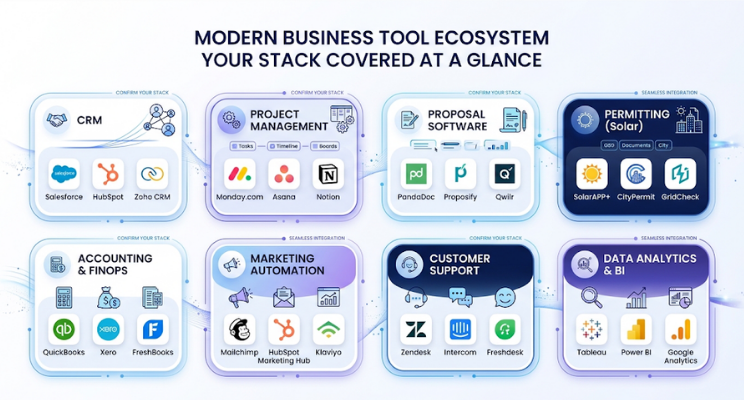
Solar Software and Tools Your Virtual Assistant Can Use
A qualified solar VA should already have experience with the tools your team uses, or be able to learn them quickly with proper onboarding.
Category | Tools |
CRM | Salesforce, HubSpot, Zoho, Aurora Solar, JobNimbus |
Project Management | Monday.com, Asana, Trello, Notion |
Proposal Software | Aurora Solar, OpenSolar, PandaDoc, Helioscope |
Communication | Slack, Microsoft Teams, Zoom |
Scheduling | Calendly, Google Calendar |
Permitting | SolarAPP+, local AHJ portals, PermitFlow |
E-Signature | DocuSign, Adobe Sign |
General Admin | Google Workspace, Microsoft 365, QuickBooks |
The right staffing partner builds a skills assessment around your specific tools before placing a candidate. You should not have to train someone on software from scratch.
How Much Does a Solar Virtual Assistant Cost
Cost varies based on experience level, scope of responsibilities, and whether you work directly with a freelancer or through a staffing partner.
Freelancers are typically less expensive on an hourly basis, but you take on all the vetting, training, and management yourself. If the fit is not right, you start over alone.
Working with a staffing partner like ClearDesk means the monthly rate includes candidate sourcing, vetting, onboarding support, and ongoing accountability. You get a pre-vetted team member who is ready to contribute, not someone you have to build from scratch.
Compare that to a U.S.-based solar project coordinator, which typically costs $50,000 to $70,000 per year in salary alone, before benefits, payroll taxes, equipment, and office overhead. A remote team member delivers equivalent output at a fraction of that cost.
One honest limitation worth naming: ClearDesk places full-time remote team members. We do not offer part-time placements or generic staffing. If you need a dedicated person who integrates fully into your operation, we are the right fit. If you need a few hours a week, a freelance platform may be a better starting point.
How to Hire a Virtual Assistant for Your Solar Company

1. Define the Role and Responsibilities
Before you search for anyone, write down the specific tasks you need covered, the software they must know, and the hours you expect them to work. Vague job briefs produce mismatched candidates. The more specific you are, the faster you find the right person.
2. Choose a Staffing Partner With Solar Experience
Evaluate virtual assistant companies based on their vetting process, their familiarity with solar operations, and the ongoing support they provide after placement. Look for partners who build custom skills assessments around your actual workflows, not generic admin tests.
ClearDesk has been recognized by Forbes for remote staffing excellence and holds a 4.9 out of 5 client satisfaction rating. We have placed remote team members across home care, solar, and other service-based industries where operational detail matters.
3. Interview and Select Your Candidate
Assess communication clarity, solar industry familiarity, reliability, and how they handle multi-step workflows. Ask them to walk through how they would manage a permit application or a proposal follow-up sequence. Their answer tells you whether they understand the work or are just describing it.
4. Onboard With Clear Processes and Tools
Provide documented workflows, CRM access, and clear communication expectations from day one. The most common reason a VA underperforms is not lack of skill. It is lack of clear instruction. Build a standard operating procedure (SOP) for each core task before your VA starts.
5. Establish Ongoing Communication and Support
Set up regular check-ins, define performance metrics, and create a feedback loop. A weekly 30-minute sync is enough to keep things aligned and catch any issues early. Treat your VA as a team member, not a task queue.
Common Mistakes When Hiring a Solar Virtual Assistant

Skipping Structured Onboarding
Assuming a VA will figure things out on their own leads to inconsistent work and slow ramp-up. Documented SOPs are not optional. They are the foundation of everything your VA does independently.
Not Providing Permitting Guidelines by Jurisdiction
Permit requirements vary significantly between cities and counties. Required forms, submission methods, correction timelines, and AHJ contacts all differ. Without jurisdiction-specific instructions, your VA will either submit incorrect applications or ask you to decide every step, which defeats the purpose.
Expecting Technical Design Expertise
A solar VA handles coordination, communication, and administrative tasks. They do not provide system design guidance, production calculations, or engineering specs. Define the escalation boundary clearly so your VA knows exactly when to hand a question to your technical team.
Failing to Define CRM Workflows Upfront
Unclear pipeline stage definitions lead to inconsistent data entry and unreliable reporting. Before granting CRM access, document exactly what qualifies a lead for each stage. A VA who knows the rules enters data correctly from day one.
Scale Your Solar Business With the Right Remote Team
The right solar virtual assistant removes the operational friction that keeps your sales team from doing what they do best. Leads get followed up. Permits get tracked. Proposals get chased. Customers stay informed. And your reps spend their time closing.
Choosing the right staffing partner matters as much as choosing the right person. Look for a partner who vets thoroughly, supports the placement after the hire, and stands behind the match.
Book a Discovery Call to talk through your solar business needs and see how a remote team member can help you close more deals and move projects faster.
Frequently Asked Questions
Q: How do solar companies ensure data security when working with a remote virtual assistant?
A: Reputable staffing partners vet candidates for reliability and provide guidance on secure access protocols. This includes VPN requirements, role-based permissions in your CRM, and signed confidentiality agreements before your VA accesses any client data.
Q: What is the typical ramp-up time for a solar virtual assistant to become fully productive?
A: Most solar virtual assistants become productive within two to four weeks. The timeline depends on the complexity of your processes and how well your onboarding documentation is prepared. VAs with prior solar or construction admin experience typically ramp up faster.
Q: Can a solar virtual assistant handle permitting for different cities and counties?
A: Yes, with proper jurisdiction-specific SOPs in place. A trained VA can manage permit submissions and follow-ups across multiple local authorities, as long as you document the requirements for each jurisdiction they will work in.
Q: How do solar companies manage a virtual assistant working in a different time zone?
A: Most solar businesses align their VA's working hours with U.S. business hours. Asynchronous communication tools like Slack and shared project management platforms keep collaboration smooth regardless of location.
Q: What happens if a solar virtual assistant placement is not a good fit?
A: Quality staffing partners offer replacement guarantees and work quickly to find a better-matched candidate. At ClearDesk, we handle this without additional fees or long delays, and we stay involved to make sure the next match is right.
Q: What is the difference between hiring a freelance virtual assistant and using a staffing agency?
A: With a freelancer, you handle all vetting, training, and management yourself. A staffing agency provides pre-vetted, trained candidates with ongoing support and accountability built into the relationship. For solar companies that need someone to own a complex operational role, the agency model produces more reliable results.