
Best Staffing Models for Home Care Scheduling in 2026


The best staffing model for caregiver scheduling depends on your agency's size, budget, and growth plans. For most growing home care agencies, a dedicated remote scheduler or a hybrid model gives you the best mix of cost, coverage, and quality. This post breaks down every major model so you can choose the right one for your agency.
Why Caregiver Scheduling Is One of the Hardest Roles in Home Care
Caregiver scheduling is not like scheduling shifts at a retail store. You are matching specific caregivers to specific clients based on skills, certifications, location, and personal fit, often on short notice.
Last-minute call-outs are constant. A caregiver calls in sick at 6 AM, and someone has to find a qualified replacement before the client's morning care visit. That pressure falls on whoever owns the scheduling function, whether that is the agency owner, an office manager, or a dedicated scheduler.
Add 24/7 coverage needs, a median caregiver turnover rate of 75%, and state-specific compliance rules, and you have one of the most demanding admin roles in home care. The person or team you put in this role shapes your care quality, your caregiver retention, and
your ability to grow.
What Is a Staffing Model for Caregiver Scheduling?
A staffing model for caregiver scheduling is the approach your agency uses to hire, structure, and manage the person or team responsible for building and maintaining the schedule. It is about who handles scheduling, not which software you use or how you design your shifts.
Your staffing model answers three questions:
Who owns the scheduling function day to day?
Are they in-house, remote, or a mix of both?
How does that structure scale as your agency grows?
Getting this right matters more than most owners realize. The wrong model creates bottlenecks, burns out staff, and leaves shifts uncovered.
Common Staffing Models for Home Care Scheduling
Owner-Managed Scheduling
Many agencies start here. The owner handles all scheduling directly, usually out of necessity. You know your caregivers and clients well, and it keeps costs low in the early days.
The problem is that this model has a short shelf life. Once you pass 10 to 15 active clients, scheduling alone can consume 20 or more hours per week. That is time you are not spending on sales, referral relationships, or growing your census.
Best for: Agencies with fewer than 10 clients just getting started.
Main risk: Owner burnout and a ceiling on growth.
In-House Scheduling Staff
This is the traditional approach. You hire a local, full-time scheduler who works from your office. They answer phones, manage the calendar, handle call-outs, and communicate directly with caregivers and clients.
The benefits are real. An in-house scheduler can walk down the hall to talk to you, attend team meetings, and build relationships with your caregivers in person. For agencies that value that physical presence, it works well.
The downsides are significant. A full-time U.S.-based scheduler typically costs $40,000 to $55,000 per year in salary alone, before benefits, payroll taxes, and paid time off. You also carry single-point-of-failure risk. When your scheduler quits or gets sick, the whole function stops.
Best for: Established agencies with a stable census that prefer on-site staff.
Main risk: High cost, turnover exposure, and limited after-hours coverage.
Outsourced or Remote Scheduling Support
This model uses trained remote team members who work as dedicated members of your agency team. They are not a call center or a shared service. They learn your systems, your caregivers, and your clients, and they function just like an in-house scheduler would, minus the physical desk.
Remote schedulers can work across time zones, which means you can extend your coverage hours without paying overtime. They typically cost 50 to 70 percent less than a comparable U.S.-based hire. At ClearDesk, our remote schedulers for home care agencies start at $2,500 per month with no long-term contract required.
This model is gaining traction fast among growing agencies. We have placed remote schedulers with home care agencies ranging from 15 to 150 caregivers, and the feedback is consistent: the output is strong, the integration is smooth, and the cost savings are real.
Tom Margolis at Interim HealthCare put it directly: "We have an outstanding scheduler that has consistently outperformed most, if not all, the employees we had doing this job previously."
Best for: Growing agencies that want professional-level scheduling without the overhead of a full-time U.S. hire.
Main risk: Requires good scheduling software and clear communication systems. If your systems are disorganized, a remote scheduler will struggle.
Hybrid Staffing Model
Some mid-sized agencies use a combination approach. An in-house coordinator handles core business hours and client-facing calls, while a remote team member covers overflow, after-hours shifts, and weekend on-call needs.
This model works well for agencies that have grown past what one person can handle but are not yet ready to build a full in-house scheduling team. It also reduces single-point-of-failure risk. If your in-house coordinator is out, the remote team member keeps things running.
Best for: Agencies with 40 or more active clients and a need for extended coverage hours.
Main risk: Requires clear handoff protocols so nothing falls through the gaps between the two roles.
Staffing Model Comparison
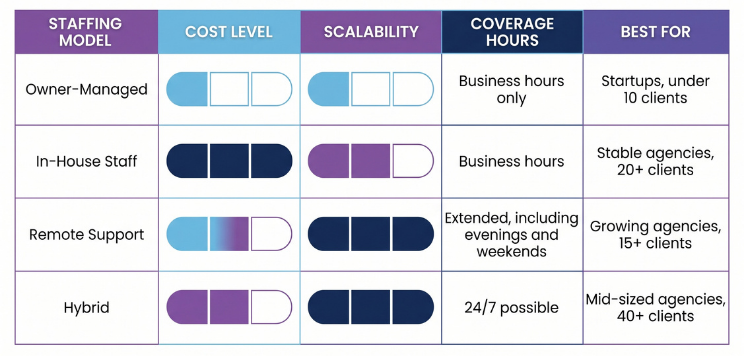
How to Choose the Right Staffing Model for Your Agency
Assess Your Client Census and Growth Plans
Start with where you are today and where you plan to be in 12 months. Ask yourself:
How many active clients do I have right now?
How many hours per week does scheduling currently take?
Am I planning to grow my census by 20 percent or more this year?
Do I have the budget to hire a full-time local scheduler?
A small agency with 12 clients may not need a dedicated scheduler yet. An agency with 30 clients and a plan to reach 60 needs a scalable solution now, not later. Building the right structure before you hit a wall is far easier than rebuilding it under pressure.
Calculate the True Cost of Your Current Approach

Most owners underestimate what scheduling actually costs them. When you add everything up, the number is often much higher than expected.
Direct labor costs: Salary, benefits, payroll taxes, and paid time off for an in-house hire
Indirect costs: Training time, turnover replacement costs, missed shifts due to gaps in coverage
Opportunity cost: Owner or manager hours spent on scheduling instead of sales, referrals, or care quality
A full-time in-house scheduler in most U.S. markets costs $50,000 to $65,000 per year when you include benefits. A remote scheduler through ClearDesk runs $2,500 per month, or $30,000 per year, with no benefits overhead and no contract locking you in.
Evaluate Your Technology and Systems
Remote and hybrid models work best when your agency uses modern scheduling software. Tools like AxisCare, ClearCare, and HHAeXchange give remote team members real-time visibility into caregiver availability, client needs, and shift status. They also support EVV requirements and HIPAA-compliant communication, which your scheduler must understand regardless of where they work.
Ask yourself:
Does my current software give remote users full access to scheduling functions?
Can caregivers and clients communicate through the platform?
Does my system integrate with payroll so scheduled hours sync automatically?
If you are still running schedules in spreadsheets or paper calendars, fix that first. No staffing model performs well without a solid system underneath it.
Consider Caregiver Retention and Satisfaction
Poor scheduling is one of the top reasons caregivers leave. Inconsistent hours, last-minute changes, and feeling like an afterthought push good caregivers out the door, with replacement costs reaching $2,600 to $5,000 per hire.
Heather Tabares, VP of Operations at Comfort Keepers, described exactly what this looks like when it works: "Our clients and caregivers have formed genuine connections with them and often ask for them by name. They are also wonderfully adaptable and always willing to learn, adjust, and grow with the needs of our business."
When caregivers feel seen and scheduled fairly, they stay longer. Lower turnover means fewer open shifts, lower recruiting costs, and better continuity of care for your clients.
Ready to see which model fits your agency? Book a Discovery Call with our team and we will walk through your current setup and give you a clear recommendation.
Best Practices for Caregiver Scheduling
Regardless of which staffing model you choose, these practices improve outcomes across the board.
Centralize Your Schedule in One System
All scheduling data must live in one platform. When your in-house coordinator uses one system and your remote team member uses another, things break. Double-bookings happen. Shifts get missed.
Pick one scheduling platform and make it the single source of truth for your entire team. Every open shift, every caregiver preference, every time-off request should live there. Tools like AxisCare and HHAeXchange are built for this.
Match Caregivers to Clients Based on Skills and Preferences
Availability alone is not enough. Effective caregiver scheduling also considers:
Certifications and care level (HHA, CNA, skilled nursing)
Client personality and preferences
Travel distance and reliable transportation
Language or cultural preferences where relevant
When you match well, clients are happier, caregivers feel more engaged, and the relationship lasts longer.
Enable Flexibility with Proper Oversight
Caregivers want some control over their schedules. Give them a structured way to request time off, swap shifts, and set availability preferences. This reduces frustration and improves retention.
At the same time, all changes should go through an approval process. Your scheduler needs to confirm that a swap does not leave a client without qualified coverage before it goes through.
Build a Reliable On-Call Backup Pool

Every agency needs a list of pre-vetted caregivers who are willing to pick up last-minute shifts. This pool is your safety net when call-outs happen, and they will happen.
Keep this list current. Know each caregiver's availability, skills, and any client restrictions. Your scheduler should be able to reach the right person within minutes, not hours.
Automate Reminders and Shift Notifications
Use your scheduling software to send automatic shift confirmations, 24-hour reminders, and alerts when a shift goes uncovered. This reduces no-shows and cuts down on the back-and-forth your scheduler handles manually.
Most modern platforms, including AxisCare and HHAeXchange, support automated SMS and email notifications. Turn these on.
Stay Compliant with Labor and Healthcare Regulations
Your scheduler must understand overtime rules, required break periods, and any state-specific home care regulations that affect how shifts are structured. In many states, schedulers also need to understand EVV requirements, which dictate how caregiver visits are logged and verified for Medicaid billing.
Non-compliance creates financial and legal risk. Make sure whoever owns your scheduling function knows these rules cold.
How Technology Supports Your Staffing Model
Good software does not replace a skilled scheduler. It makes a skilled scheduler far more effective.
Whichever staffing model you choose, look for scheduling software with these features:
Real-time availability tracking: See which caregivers are open before you call them
Automated shift matching: Cited by 64% of home care leaders as the most impactful AI application, the system suggests the best-fit caregiver based on your criteria
Mobile access: Caregivers and schedulers can view and update the schedule from anywhere
Integration with payroll and billing: Scheduled hours flow directly into your payroll and invoicing systems without manual entry
AxisCare, ClearCare, and HHAeXchange are all built for home care and support these features. The right tool for your agency depends on your size and existing systems.
What Effective Caregiver Scheduling Looks Like
When the right staffing model is in place, scheduling stops being a daily crisis. Shifts get covered. Caregivers know their schedules in advance. Clients see familiar faces. And the agency owner is not fielding calls at 10 PM on a Sunday.
Jeff Pitts, Owner and CEO of Comfort Keepers Western Colorado, described the shift after placing a dedicated remote scheduler: "He's become confident handling complex scheduling, assisting with confirmations, and ensuring clarity in all tasks. His work ethic, documentation, and collaboration with the scheduling team have made a meaningful impact on our day-to-day operations."
That is the outcome you are building toward. A scheduling function that runs without you having to touch it every day, staffed by someone who takes real ownership of the role.
We have seen this pattern repeat across dozens of home care agencies we have worked with at ClearDesk. When you put the right person in the right model, the whole operation gets more stable.
How to Build a Scalable Scheduling Operation
Here is how to audit your current approach and move toward a model that scales.
Track your time. For one week, log every hour you or your team spends on scheduling tasks. Include call-outs, shift fills, caregiver calls, and system updates. This number is your baseline.
Calculate your true cost. Add up direct labor, indirect costs, and opportunity cost using the framework above.
Identify your biggest pain points. Is it after-hours coverage? Caregiver turnover? Shift gaps? Knowing where the system breaks most often tells you what your model needs to solve.
Match the model to your stage. Use the comparison table above as a guide. If you are under 15 clients, owner-managed may still work. If you are at 30 or more, you need dedicated support.
Choose your software first. Before you hire or place a scheduler, make sure your platform is ready. A remote scheduler working in a broken system will not succeed.
Onboard with structure. Whether you hire in-house or bring on a remote team member, document your scheduling process before day one. Clear SOPs make onboarding faster and results more consistent.
Many growing agencies find that a dedicated home care virtual assistant trained in scheduling gives them the fastest path to a stable, scalable operation. At ClearDesk, we vet over 55,000 applicants per quarter and accept fewer than 0.5 percent of candidates, so the person we place is already trained and ready to contribute quickly.

Kayla Spurlock, HR and Scheduling Manager at Home Instead, said it well: "She's made such a huge impact on our organization in just three short months, it honestly feels like she's been part of the team much longer."
That kind of fast impact is what you should expect from the right placement.
Book a Discovery Call to see how a dedicated remote scheduler can support your agency's scheduling needs.
Frequently Asked Questions
Q: What is the best scheduling software for caregivers in home care?
A: Look for software with real-time caregiver availability, automated shift matching, mobile access, and EVV support. AxisCare, ClearCare, and HHAeXchange are all strong options built specifically for home care agencies. The best choice depends on your agency size, billing setup, and existing systems.
Q: How much does a dedicated home care scheduler cost?
A: Costs vary significantly by model. A full-time in-house U.S.-based scheduler typically runs $50,000 to $65,000 per year including benefits and payroll taxes. A dedicated remote scheduler through ClearDesk starts at $2,500 per month with no long-term contract, which can represent savings of 50 percent or more while maintaining a high level of quality.
Q: What qualifications should a caregiver scheduler have?
A: Strong communication skills, attention to detail, and the ability to stay calm under pressure are the most important traits. Familiarity with home care operations, knowledge of state labor and EVV requirements, and proficiency with scheduling software are also essential. Experience with caregiver-client matching and on-call management is a strong plus.
Q: How do remote schedulers communicate with caregivers and clients?
A: Remote schedulers use the same tools as in-house staff, including phone, text, email, and your scheduling platform. Most home care software supports direct communication through the system, so caregivers and clients interact with their scheduler the same way regardless of where that person is located. Modern tools make physical location largely irrelevant for this role.
Q: Can a remote scheduler handle after-hours or weekend scheduling needs?
A: Yes. This is one of the key advantages of the remote model. Remote team members can be structured to cover evening and weekend hours that a standard in-house scheduler working 9 to 5 cannot. Agencies that need true 24/7 coverage often use a hybrid model, pairing a remote scheduler for extended hours with an in-house coordinator for core business hours.
Q: Is ClearDesk a good fit for small home care agencies?
A: ClearDesk works best with agencies that have an active client census and a clear need for dedicated scheduling support. We do not offer part-time placements or shared staffing arrangements. If your agency is not yet at the stage where a full-time dedicated scheduler makes sense, we will tell you that honestly on the first call rather than place someone before you are ready.


