Professional Insurance Virtual Assistants for Agency Growth


Virtual assistants for insurance are remote professionals who handle the administrative and operational work that keeps your agency running, so your licensed agents can focus on selling and building client relationships. At ClearDesk, we place dedicated insurance virtual assistants with agencies of all sizes, and the results are consistent: less time on paperwork, faster client response, and more capacity for growth.
This guide covers everything you need to know, from what tasks a virtual assistant can own, to how much it costs, to how to onboard one the right way.
What an Insurance Virtual Assistant Does for Your Agency
An insurance virtual assistant is a trained remote professional who works as a dedicated member of your team. They are not a freelancer you find on a job board. They are not shared across dozens of clients. They show up every day, learn your systems, and take ownership of the tasks that slow your agency down.
At ClearDesk, we screen more than 55,000 applications per quarter and accept fewer than 0.5% of candidates. The people we place have strong communication skills, attention to detail, and the ability to learn insurance-specific workflows quickly.
The key distinction is this: an insurance virtual assistant handles non-licensed administrative and support work. They cannot sell policies, bind coverage, or give advice that requires a license. What they can do is everything else that takes time away from your producers.
Tasks an Insurance Agency Virtual Assistant Can Handle
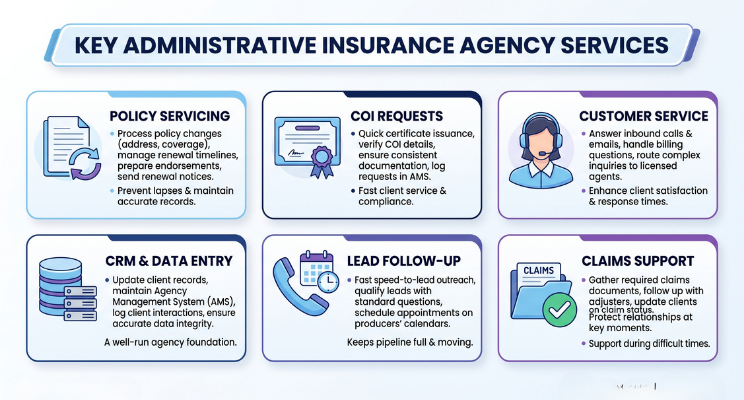
This is the question most agency owners ask first, and it is the right one. Knowing exactly what you can delegate is what makes the decision clear.
Policy Servicing and Renewals
Policy changes and renewals are high-volume, time-consuming, and easy to delegate once your VA knows your systems.
Policy changes: Processing address updates, coverage modifications, and beneficiary changes in your agency management system
Renewal management: Tracking expiration dates, sending renewal notices, and following up with clients before policies lapse
Endorsements: Pre-filling endorsement forms and routing them for licensed agent review
Certificate of Insurance Requests

COI requests are one of the most common tasks agencies outsource to virtual assistants. With CSRs processing an average of 28 per week, the volume is high, the process is repeatable, and delays frustrate clients fast.
Your VA can log each request, verify the details, issue the certificate through your AMS, deliver it to the client, and save the completed document to the file. What used to take your team 20 minutes per request becomes a background task.
Customer Service and Inbound Calls
Your VA can answer inbound calls, respond to emails, and handle basic client questions without pulling a licensed agent into the conversation. They route anything that requires a license to the right person.
If your agency serves Spanish-speaking clients, bilingual virtual assistants are available. This is a real advantage in markets where language barriers affect client retention.
Data Entry and CRM Management
Accurate records are the foundation of a well-run agency. Your virtual assistant can maintain client files, update contact information, log every interaction, and keep your AMS current.
Common platforms our VAs work in include Applied Epic, HawkSoft, EZLynx, AMS360, and AgencyZoom. Many arrive with prior exposure to these tools and get up to speed quickly.
Lead Follow-Up and Appointment Setting
Speed to lead matters in insurance — the first responder closes 78% of deals. A VA can reach out to new leads within minutes, qualify them with a set of standard questions, and schedule appointments directly on your producers' calendars.
This keeps your pipeline active without asking your agents to stop selling to do admin work.
Claims Support and Documentation
When a client files a claim, they want updates. Your VA can gather the required documents, follow up with adjusters, and keep the client informed throughout the process. This protects the relationship at a moment when it matters most.
Benefits of Hiring a Virtual Assistant for Insurance Agents
The tasks above are the "what." The benefits are the "why it changes your agency."
Reduce Administrative Burden
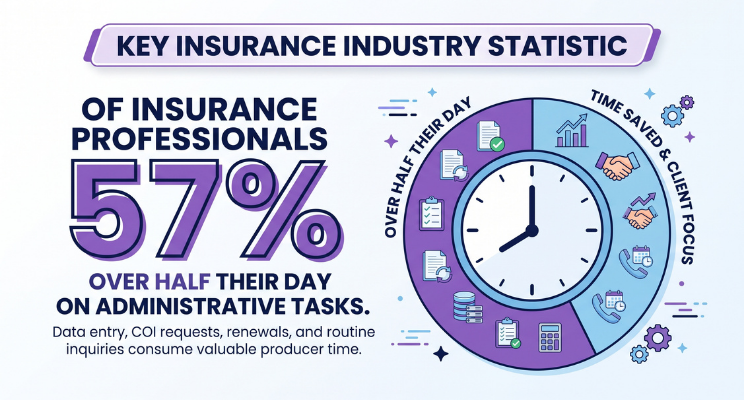
57% of insurance professionals spend more than half their day on administrative tasks. Data entry, COI requests, renewal calls, and follow-up emails are necessary, but they do not need to be done by your highest-paid people.
When a virtual assistant takes that work, your agents get their time back. That time goes toward selling, advising clients, and building the relationships that drive retention.
Lower Staffing Costs
A full-time local hire comes with salary, benefits, payroll taxes, office space, equipment, and turnover costs. When that person leaves, you start the process over.
A virtual assistant through ClearDesk starts at $2,500 per month with no long-term contract. There are no benefits to manage, no office space required, and no equipment to provide. Through global staffing, the savings are significant and the flexibility is real.
Improve Customer Response Times
Clients who wait hours for a response on a COI request or a billing question start looking elsewhere. A dedicated virtual assistant handles those requests quickly and consistently.
Faster response times directly affect retention. Clients stay when they feel taken care of.
Free Up Time for Sales and Client Relationships
This is the strategic shift that makes the biggest difference. When your producers are not buried in admin work, they sell more. When your agency owner is not answering routine calls, they can focus on growth.
A virtual assistant does not just save time. It changes what your team is able to do with that time.
How Much Does an Insurance Virtual Assistant Cost
Cost is a top question for most agency owners, and the answer depends on the model you choose.
Typical Pricing Models for Insurance Virtual Assistants
Pricing Model | Description |
Monthly flat rate | Fixed fee for full-time dedicated support, predictable and easy to budget |
Hourly rate | Pay only for hours worked, common with freelance or on-demand services |
Tiered packages | Different service levels based on experience, skills, and task complexity |
At ClearDesk, we use a monthly flat-rate model starting at $2,500 per month. There is no long-term contract, which means you are not locked in if your needs change.
Cost Comparison with U.S. Based Employees
A local administrative hire costs far more than the base salary. Add health insurance, paid time off, payroll taxes, onboarding costs, and the time your team spends managing HR, and the true cost climbs quickly.
Virtual assistants eliminate most of those costs. No benefits packages. No payroll taxes. No office overhead. No turnover disruption. For agencies running on tight margins, global staffing delivers meaningful savings without sacrificing quality.
Calculating Total Cost of Ownership
When you compare options, look beyond the monthly fee. Consider how long it takes a VA to become fully productive, how much management time is required, and whether your provider offers ongoing support after placement.
A cheaper option that requires six weeks of ramp-up and constant supervision may cost more in the long run than a well-trained VA who is productive within the first two weeks.
Human Virtual Assistants vs AI for Insurance Agencies

This comparison comes up often, and it is worth addressing directly. AI tools can handle certain scripted tasks, but insurance work involves nuance that AI consistently struggles with.
When Human VAs Outperform AI Solutions
Complex client interactions: A client calling after a claim denial needs empathy and judgment, not a script. Human VAs read the situation and respond accordingly.
Relationship building: Clients remember how they were treated. A human VA builds rapport over time. AI does not.
Compliance-sensitive tasks: Insurance involves state-specific rules, carrier-specific requirements, and E&O considerations. Human VAs can be trained to navigate these. AI tools often cannot.
Adaptability: When something unexpected happens, a human VA can think through it. AI follows the workflow it was given and stops when the workflow does not apply.
Limitations of AI Virtual Assistants for Insurance Work
AI handles high-volume, scripted tasks reasonably well. Routing calls, sending reminders, and pulling standard reports are within its range.
Where AI falls short is in the judgment-based work that defines most of insurance. A client asking why their premium went up, a COI request with non-standard language, or a claims follow-up that requires reading the adjuster's tone — these require a person. The agencies we work with that have tried AI-only solutions often come back to human VAs for exactly this reason. The most effective approach is using AI and virtual assistants together, where AI handles the scripted volume and your VA handles everything that requires judgment.
How to Evaluate Insurance Virtual Assistant Services
Not all virtual assistant companies are the same. Here is what to look for when comparing your options.
Insurance Industry Expertise and Compliance Knowledge
A VA who does not know what an endorsement is will slow you down, not help you. Look for providers who train their VAs in insurance terminology, carrier workflows, and compliance basics like data privacy and TCPA guidelines.
At ClearDesk, we match each client with a VA based on their specific agency type, lines of business, and systems. We do not send a general admin and hope for the best.
Vetting and Training Standards
Ask every provider how they screen candidates. What does their process look like? How many applicants do they reject? What skills do they test for?
Our Talent Assurance Protocol includes multi-stage screening, skills testing, communication evaluation, and background verification. We accept fewer than 0.5% of applicants, which means the person placed with your agency is genuinely qualified.
Technology and AMS Compatibility
Your VA needs to work in the systems your agency already uses. Before committing to a provider, confirm their VAs have experience with your platform.
Common systems our VAs work in:
Applied Epic
HawkSoft
EZLynx
AMS360
AgencyZoom
Ongoing Support and Performance Accountability
The best providers do not disappear after placement. They stay involved, monitor performance, and step in when something is not working.
We maintain close contact with both the agency and the VA after placement. If a match is not right, we address it quickly. Our client satisfaction rating is 4.9 out of 5, and that number reflects what happens after the hire, not just during it.
Integrating a Virtual Assistant with Your Agency Management System
Getting your VA set up in your systems is straightforward when you plan it correctly.
Insurance Platforms Virtual Assistants Can Use
Trained VAs can work across all major AMS platforms. Many of the VAs we place have prior experience in Applied Epic, HawkSoft, EZLynx, AMS360, and AgencyZoom before they ever start with your agency. This cuts down the time it takes to reach full productivity.
Setting Up Secure Access and Workflows
Start by granting role-appropriate access only. Your VA does not need admin-level permissions on day one. Set up secure login credentials, enable multi-factor authentication, and document your standard operating procedures before the VA starts.
Written SOPs are the single most important thing you can do to speed up onboarding. If the process lives only in your head, your VA will spend the first few weeks asking questions that could have been answered on page one of a document.
How to Onboard a Virtual Insurance Assistant

A structured onboarding process gets your VA productive faster and reduces frustration on both sides. Here is how we recommend doing it.
1. Define Roles and Responsibilities
Before your VA starts, write down exactly what they will own. A clear job description with a specific task list removes ambiguity and sets expectations from day one.
Vague instructions like "help with customer service" lead to confusion. Specific instructions like "respond to all COI requests within two hours using the standard template in the shared drive" lead to results.
2. Provide Insurance-Specific Training
Cover your agency's products, your carrier relationships, your AMS workflows, and your communication standards. Record training sessions so your VA can refer back to them.
Some providers, including ClearDesk, place VAs who already have insurance training. This shortens the ramp-up period significantly. Even so, every agency has its own way of doing things, and that context takes time to transfer.
3. Establish Communication Protocols
Decide how your VA will communicate with your team. Set up a preferred channel for routine updates, a separate channel for urgent issues, and a clear escalation path for anything that requires a licensed agent.
Daily check-ins during the first few weeks are worth the time. They surface problems early and build the working relationship faster.
4. Set Performance Expectations and KPIs
Define what success looks like in measurable terms. How many COI requests should be processed per day? What is the target response time for inbound calls? How many renewal outreach attempts should be made each week?
Review these metrics regularly. Monthly reviews during the first quarter are a good cadence. Adjust as the role evolves.
Results to Expect from Insurance Virtual Assistant Services
We have placed virtual assistants with insurance agencies across the country. Here is what agencies consistently report after the first 90 days.
Productivity Gains and Time Savings
Agencies reclaim hours every week that were previously spent on data entry, COI requests, renewal follow-up, and inbound calls. Those hours go back to producers and agency owners.
Tom Margolis at Interim HealthCare put it clearly: "We have an outstanding scheduler that has consistently outperformed most, if not all, the employees we had doing this job previously." That kind of result comes from placing the right person in the right role with a clear process.
Faster Lead Response and Higher Conversion
When a VA handles lead follow-up, response times drop from hours to minutes. Leads that used to fall through the cracks get called, qualified, and scheduled. Producers show up to appointments instead of chasing contacts.
The agencies we work with see this shift quickly. It is one of the most immediate and measurable improvements after a VA is placed.
Improved Customer Retention
Clients who get fast, consistent service do not leave. A VA who answers calls, sends renewal reminders, and follows up on claims keeps clients engaged between policy reviews.
Retention is where the long-term value of a virtual assistant shows up most clearly. Reducing churn by even 5% can lift profits by 25–95%, a compounding effect on agency revenue.
Measurable Cost Savings and ROI
Agencies that replace a local administrative hire with a virtual assistant see direct savings from day one. When that VA also frees up producer time that converts to new business, the return compounds.
The math is straightforward: lower staffing costs plus higher production capacity equals a healthier agency.
Ready to see how this works for your agency? Book a Discovery Call and we will walk you through the process.
How to Choose the Right Virtual Assistant for Your Insurance Agency
The provider you choose matters as much as the VA you hire. Here is how to evaluate your options.
Questions to Ask Prospective VA Providers
What is your vetting and selection process, and what percentage of applicants do you accept?
Do you provide insurance-specific training before placement?
What ongoing support do you offer after the VA starts?
How do you handle replacements if the match is not right?
Do your VAs sign confidentiality and data protection agreements?
If a provider cannot answer these questions clearly, that tells you something important about whether they are the right outsourcing provider for your agency.
Security and Compliance Considerations
Your clients' data is sensitive. Your VA will have access to personal information, policy details, and financial records. Every provider you consider should require confidentiality agreements, enforce secure login protocols, and follow data protection standards.
If your agency handles health-related coverage, HIPAA awareness is relevant. Confirm your provider understands these requirements and trains their VAs accordingly.
Replacement Guarantees and Risk Mitigation
No placement is guaranteed to be perfect. What matters is how your provider handles it when the fit is not right.
At ClearDesk, we address replacement situations quickly and without additional fees. We have the candidate pipeline to move fast, and we do not leave agencies without support while a replacement is found. This is a direct reflection of how we operate: we stay involved after the hire, not just before it.
Grow Your Insurance Agency with the Right Remote Team
The agencies that grow consistently are not the ones with the most staff. They are the ones with the right people in the right roles, doing the right work.
A well-placed insurance virtual assistant changes the math for your agency. Your producers sell more because they are not buried in admin work. Your clients get faster responses because someone is dedicated to handling their requests. Your overhead stays lower because you are not paying for office space, benefits, and turnover.
We have seen this play out across hundreds of placements. The pattern is consistent: agencies that commit to the process, set clear expectations, and work with a provider that stays accountable see real results.
If you are ready to build a remote team that actually performs, Book a Discovery Call and let us show you how we do it.
Frequently Asked Questions
Q: Can a virtual assistant perform licensed insurance activities? A: No. Virtual assistants handle administrative and support tasks only. They cannot sell policies, bind coverage, or provide advice that requires a state insurance license. Licensed agents on your team handle those activities, while the VA handles everything else that supports the process.
Q: How do insurance agencies manage time zone differences with offshore virtual assistants? A: Most offshore VAs work U.S. business hours, so time zone differences rarely cause issues in practice. Agencies set overlapping schedules, establish clear communication channels, and define response time expectations upfront. The result is a working relationship that feels no different from working with a local team member.
Q: What happens if an insurance virtual assistant does not meet expectations? A: Reputable providers handle replacements without additional fees and without leaving your agency without support. At ClearDesk, we address performance issues quickly, work with the agency to identify what is not working, and find a better match. Our process is built to make replacements fast and low-friction.
Q: How long does it take for an insurance virtual assistant to become fully productive? A: Most VAs with insurance training reach full productivity within two to four weeks, depending on task complexity and how well the agency has documented its processes. Agencies with clear SOPs and a structured onboarding plan see faster ramp-up times than those who train on the fly.
Q: Do insurance virtual assistants sign confidentiality and data protection agreements? A: Yes. Professional VA providers require their team members to sign confidentiality agreements and follow documented data security protocols. This protects your clients' sensitive information and reduces your agency's exposure to data-related risk.
Q: Is there a minimum commitment to hire an insurance virtual assistant through ClearDesk? A: ClearDesk placements start at $2,500 per month with no long-term contract. You are not locked into a multi-year agreement. This structure gives agencies the flexibility to scale up or adjust as their needs change, without the risk that comes with traditional hiring commitments.