Virtual Assistants for HVAC Companies: Benefits, Tasks, and Costs

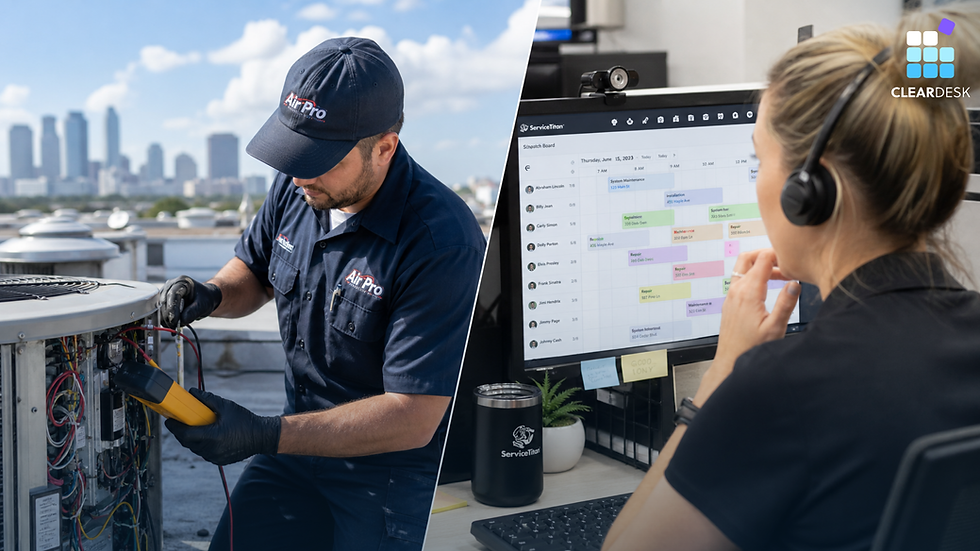
HVAC virtual assistants are remote professionals trained to handle the daily operations of a heating and cooling business, from dispatch coordination and technician scheduling to billing, customer calls, and CRM updates. They work during your business hours, inside your software, and function like a core team member without the cost of a local hire. If you're running an HVAC company and spending hours each week on admin work instead of service calls, this is the model worth understanding.
What Is an HVAC Virtual Assistant
An HVAC virtual assistant is a remote team member who supports the back-office and front-office operations of a heating and cooling business. They handle tasks like scheduling service calls, coordinating dispatch, generating invoices, answering inbound calls, and managing records inside field service platforms.
Unlike a general admin hire, an HVAC virtual assistant works inside the tools your team already uses. They log into your field service management (FSM) software, follow your dispatch process, and communicate with your customers and technicians just like an in-house employee would.
At ClearDesk, we call these professionals Remote Team Members. They are vetted, trained, and placed to match your specific workflows, not handed off from a generic roster.
How HVAC Virtual Assistants Differ from General Assistants

A general virtual assistant can handle basic admin tasks. An HVAC virtual assistant understands how a field service business actually runs.
Here is what sets them apart:
Industry knowledge: They know the difference between a maintenance call and an emergency dispatch. They understand priority levels, seasonal demand spikes, and how to communicate with technicians in the field.
Software proficiency: They have experience in FSM platforms like ServiceTitan, Housecall Pro, and Jobber, not just general tools like Gmail or Google Calendar.
Workflow understanding: They know how to manage a dispatch board, track job status in real time, follow up on unpaid invoices, and handle a full day of inbound service requests without hand-holding.
A general VA hired for an HVAC company often creates more work than they save. You end up managing them instead of delegating to them. An HVAC-trained remote team member starts contributing from day one.
Benefits of Hiring an HVAC Virtual Assistant
Lower Staffing Costs Compared to Local Hires

Sourcing talent globally reduces your payroll cost without reducing quality. A full-time local dispatcher or admin hire typically costs $45,000 to $65,000 per year in base salary, plus benefits, taxes, and equipment. An HVAC virtual assistant through ClearDesk starts at $2,500 per month, with no benefits overhead, no equipment costs, and no long-term contract required.
Those savings can go directly back into your business, whether that means new equipment, a marketing push, or hiring another technician.
More Time for Revenue-Generating Work
Every hour you spend on scheduling, invoicing, or answering routine calls is an hour you are not on a job site or closing a new account. When you hand those tasks to a trained remote team member, your technicians stay booked and your time goes toward work that actually grows revenue.
We have seen HVAC owners recover 15 to 25 hours per week after placing a virtual assistant. That time compounds fast.
Faster Invoicing and Improved Cash Flow

Delayed invoices are a direct cash flow problem — 56% of small businesses carry unpaid balances averaging $17,500 each, according to Intuit QuickBooks. An HVAC virtual assistant generates invoices as jobs close, submits them to customer portals, and follows up on unpaid accounts before they age. Faster billing means faster payment, and that keeps your operation running without gaps.
Scalable Support Without Adding Overhead
HVAC demand peaks in summer and winter and slows in spring and fall. Hiring a full-time employee for peak capacity creates fixed overhead you carry all year. A remote team member gives you the flexibility to scale support up during busy seasons without adding permanent headcount.
Consistent Customer Response and Follow-Up
Missed calls and slow follow-ups cost HVAC companies leads every single week — a survey published in Entrepreneur found 42% of SMBs lose $500+ monthly to unanswered calls alone. An HVAC virtual assistant answers inbound calls, books appointments, confirms service times, and follows up with open estimates. Your customers get a response every time, and no lead slips through because someone was too busy to call back.
Tasks an HVAC Virtual Assistant Can Handle

HVAC virtual assistants support a wide range of functions across operations, customer service, billing, and administration. Here is what they typically own:
Dispatch and Technician Scheduling
They coordinate service calls, assign jobs based on technician location and availability, update the dispatch board in real time, and communicate schedule changes to both customers and field staff. This is one of the highest-value tasks you can hand off.
Billing and Invoice Processing
They generate invoices from completed work orders, submit to customer portals, track payment status, and follow up on overdue accounts. This keeps your accounts receivable current and your cash flow predictable.
Customer Service and Inbound Call Handling
They answer inbound calls, book service appointments, handle routine customer questions, and act as a virtual receptionist for your HVAC business. Customers get a live, professional response without you needing to staff a front desk.
CRM and Field Service Software Management
They update job records, maintain customer databases, and keep your FSM platform accurate. Whether you use ServiceTitan, Housecall Pro, or Jobber, a trained HVAC virtual assistant works inside those systems daily.
Lead Follow-Up and Marketing Coordination
They follow up on open estimates, send maintenance reminders, manage email campaigns, and support your marketing efforts. Leads that would otherwise go cold get a timely response.
HR and Back-Office Administration
They assist with onboarding paperwork for new hires, support payroll prep, post job listings, screen resumes, and handle general administrative tasks. This frees up your operations team to focus on running the business.
How Much Does an HVAC Virtual Assistant Cost
Cost is one of the first questions HVAC owners ask, and it is a fair one. Here is a direct answer.
Common Pricing Models
Hourly rates: Common with freelance platforms. You pay per hour worked, but quality and reliability vary widely.
Monthly flat rates: A set monthly cost for dedicated, full-time support. This is the model ClearDesk uses, starting at $2,500 per month with no long-term contract.
Part-time vs. full-time: Some providers offer part-time arrangements. ClearDesk places full-time remote team members only, which ensures consistency and real integration into your operations.
One honest limitation worth naming: if you only need a few hours of help per week, a managed staffing model like ours may not be the right fit. We focus on full-time placements because that is where the results are.
Cost Comparison with In-House Hires

Remote team members cost significantly less than U.S.-based employees for the same role. The savings are real, and they start from month one.
Tools HVAC Virtual Assistants Use
Experienced HVAC virtual assistants arrive with proficiency in the tools your business already runs on, or they can be trained quickly.
Field service management: ServiceTitan, Housecall Pro, Jobber
Communication: Phone systems, Slack, email platforms
Scheduling and dispatch: Built into FSM platforms or standalone scheduling tools
Invoicing and payments: QuickBooks, integrated billing within FSM platforms
When we place a remote team member with an HVAC company, we confirm software fit before the first day. There is no learning curve on tools that matter most to your daily operations.
How Remote HVAC Dispatch Coordination Works

Dispatch is one of the most common and highest-value tasks HVAC companies hand to virtual assistants. Here is exactly how it works in practice.
1. Receiving and Logging Service Requests
The virtual assistant monitors inbound calls, emails, and online requests. They enter job details into your FSM platform as requests come in, so nothing gets missed and every job is tracked from the start.
2. Assigning Jobs to Available Technicians
The VA reviews technician schedules, current locations, and skill sets to match the right person to each job. They update the dispatch board in real time and notify technicians of their assignments through your communication channel.
3. Monitoring Active Jobs Throughout the Day
The VA tracks job status as technicians check in and out. They handle reschedules, communicate updates to customers, and flag any issues that need attention before they become problems.
4. Completing End-of-Day Job Reviews
At the end of each shift, the VA confirms which jobs closed, flags any incomplete work orders, and prepares a summary for the next day. This keeps your operations team informed and your billing team ready to invoice.
I have spoken with HVAC owners who assumed dispatch could not work remotely. After seeing this workflow in action, the concern disappears. The entire process runs through software, and a trained VA manages every stage without needing to be on-site.
Book a Discovery Call to see how this model fits your operation.
Mistakes to Avoid When Hiring an HVAC Virtual Assistant

1. Hiring Without HVAC-Specific Experience
A general VA may not understand dispatch urgency, field service terminology, or how to handle a customer calling about a no-heat emergency in January. Hire someone trained in field service workflows, not someone who will need weeks of context before they can contribute.
2. Skipping the Vetting Process
Screening matters more than most business owners realize. At ClearDesk, we process more than 55,000 applications per quarter and accept fewer than 0.5% of candidates. That level of filtering is what separates a reliable remote team member from a costly mistake. Ask any provider how they screen before you commit.
3. Delegating Complex Tasks Too Soon
Start with structured, repeatable tasks like call handling, scheduling, and data entry. Once your VA knows your systems and workflows, you can hand over higher-stakes responsibilities like billing and dispatch coordination.
4. Overlooking Time Zone and Communication Needs
Your VA needs to work during your business hours. Confirm this before hiring. Also set clear expectations for how and when they communicate with your team. Misaligned hours or unclear channels create gaps that hurt your customers.
How to Hire an HVAC Virtual Assistant
Follow these steps to get the right person in place quickly:
Define the role. List the specific tasks you need handled and the hours required. Be exact. "Help with scheduling" is too vague. "Manage the ServiceTitan dispatch board from 7 AM to 4 PM Monday through Friday" is clear.
Choose a sourcing method. Freelance platforms give you options but require you to vet candidates yourself. Staffing agencies handle sourcing but vary widely in quality. A managed provider like ClearDesk handles sourcing, vetting, and ongoing support so you can focus on running your business.
Evaluate candidates. Review experience with HVAC-specific software, communication skills, and prior field service work. Ask for examples of dispatch or billing tasks they have handled.
Onboard with structure. Give your VA access to your systems, a written process for key tasks, and a point of contact for questions. Schedule regular check-ins during the first 30 days.
Working with a staffing partner simplifies every step. You skip the sourcing and screening work and get a pre-vetted candidate matched to your specific needs.
For more on how this model applies to field service and home care operations, see our full guide on home care virtual assistants.
A Real Example: What This Looks Like in Practice
Tom Margolis, owner of an Interim HealthCare franchise, shared this after working with ClearDesk:

Tom's situation mirrors what we hear from HVAC owners regularly. The admin and scheduling work piles up, local hires underperform or leave, and the business owner ends up absorbing the gap. A well-placed remote team member solves that problem and often outperforms what a local hire would have delivered.
ClearDesk holds a 4.9 out of 5 client satisfaction rating and has been recognized by Forbes for remote staffing excellence. Those results come from a process that prioritizes fit, not just speed of placement.
Build a Leaner HVAC Operation with the Right Remote Team
HVAC companies that add a trained virtual assistant stop losing hours to admin work and start running tighter operations. Dispatch gets handled. Invoices go out on time. Calls get answered. And the owner gets their time back.
The right remote team member does not just reduce your workload. They make your business more consistent, more responsive, and more ready to grow.
Book a Discovery Call to talk through your specific needs and see how ClearDesk's Remote Team Members can support your HVAC business.

Frequently Asked Questions
Q: Can an HVAC virtual assistant handle after-hours emergency calls?
A: Many HVAC virtual assistants can cover extended or after-hours shifts depending on your arrangement with your staffing provider. If after-hours coverage is a priority, discuss scheduling needs during the hiring process so your VA's hours align with your on-call window.
Q: How long does it take to onboard an HVAC virtual assistant?
A: Most HVAC virtual assistants can begin contributing within one to two weeks. When you work with a provider that pre-trains candidates on field service workflows and common FSM software, the ramp time is shorter because they arrive with relevant skills already in place.
Q: What happens if my HVAC virtual assistant does not work out?
A: Reputable staffing providers offer replacement support if a placement is not the right fit. At ClearDesk, we move quickly when a replacement is needed and handle the vetting and transition so your operations stay on track with minimal disruption.
Q: Do HVAC virtual assistants work in my time zone?
A: Most providers match virtual assistants to your business hours. Confirm this before hiring. Your VA should be available during your operating hours, not working on an offset schedule that creates communication gaps during peak dispatch periods.
Q: Can an HVAC virtual assistant help recruit technicians?
A: Yes. Virtual assistants can support recruiting by posting job listings, screening resumes, scheduling interviews, and following up with candidates. This is especially useful given that the HVAC industry faces roughly 110,000 unfilled positions nationwide according to SMACNA, and growing companies need a steady pipeline of qualified technicians without dedicating owner time to HR tasks.
Q: Is an HVAC virtual assistant the same as a virtual receptionist? A: There is overlap, but an HVAC virtual assistant typically handles a broader range of tasks. A virtual receptionist focuses on answering calls and booking appointments. An HVAC virtual assistant also manages dispatch, billing, CRM updates, and back-office work, making them a more complete operational resource for a field service business.