
What Should an Outsourcing Partner Handle? Key Responsibilities Explained


An outsourcing partner should handle the tasks that pull your attention away from running your business. That includes scheduling, recruiting support, admin work, customer service, bookkeeping, and more. But a true partner also handles the behind-the-scenes work of finding, training, and managing the people who do that work for you.
Most business owners we talk to at ClearDesk already know they need help. What they don't know is exactly where to draw the line between what to keep and what to hand off. This post answers both questions directly.
What tasks should you outsource to a remote team?
The right tasks to outsource share a few traits: they're repeatable, they don't require physical presence, and they consume time that could go toward growing your business. Here's a breakdown by function.
Scheduling and coordination
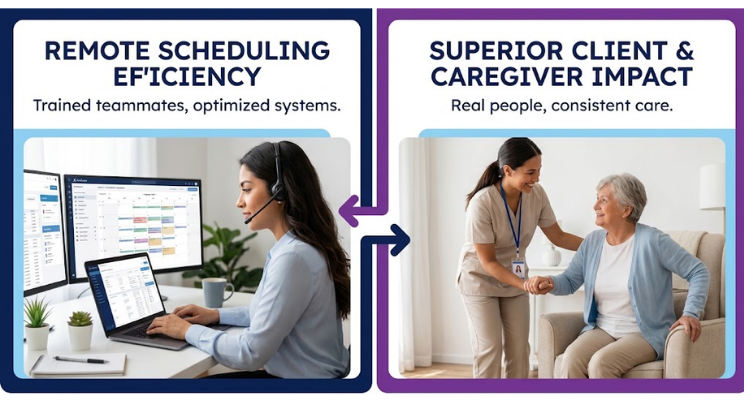
Scheduling is one of the highest-volume, most time-sensitive roles in any service business. In home care especially, where 59% of agencies report insufficient staffing, a missed shift or a late fill can affect a client's safety. That's why ClearDesk scheduling coordinators are among the most common roles we place at ClearDesk.
A remote scheduler can manage shift coverage, handle caregiver confirmations, update platforms like AxisCare, ClearCare, and HHAeXchange, and flag gaps before they become problems. This work doesn't require someone to be in your office. It requires someone reliable, detail-oriented, and trained on your systems.
Tom Margolis of Interim HealthCare put it this way: "We have an outstanding scheduler that has consistently outperformed most, if not all, the employees we had doing this job previously." That kind of result is possible when the right person is placed in the role with proper training from day one.
If you want to learn more about what this role looks like in practice, visit our home care virtual assistant page.
Recruiting and HR support
Sourcing candidates, screening applications, scheduling interviews, and managing onboarding paperwork are all repeatable tasks. None of them require your recruiter to sit in your building.
A remote recruiting coordinator can post jobs, review resumes, conduct initial screens, and keep your hiring pipeline moving. Brenda K. Rubalcaba, Client Care Manager at Synergy Homecare, shared this about her ClearDesk team member: "She has been amazing with recruiting, communicating with the caregivers and applicants. There is not a task that she has been given that she has not completed."
Administrative and back-office functions
Admin work is often the first thing that buries an owner. A remote admin can take on:
Data entry and record updates across your CRM or care management platform
Document management, including filing, organizing, and tracking compliance records
Calendar coordination for leadership and care teams
Email inbox management, including routing, flagging, and drafting responses
Reporting support, pulling weekly or monthly data into a format you can act on
These tasks are low-risk to delegate and high-impact when done consistently.
Customer service and client communication
Inbound calls, follow-up messages, intake inquiries, and support tickets all need a fast, professional response. A remote customer service rep can handle first-contact communication, route complex issues to the right person, and keep your clients from waiting.
The key here is communication skill. We screen every candidate for English proficiency, tone, and clarity before they ever speak to a client. Heather Tabares, VP of Operations at Comfort Keepers, noted: "Our clients and caregivers have formed genuine connections with them and often ask for them by name."
Sales development and lead qualification
A sales development rep (SDR) handles the early stages of your pipeline. That means outbound prospecting, follow-up calls, CRM updates, and appointment setting. Your sales team or owner closes deals. The outsourced SDR does the groundwork that makes that possible.
This role works well remotely because it runs entirely through phone, email, and CRM tools. We've placed SDRs for home care agencies, real estate brokerages, and service businesses of all sizes.
Marketing and social media coordination
At the execution level, marketing tasks are very easy to delegate. A remote marketing coordinator can:
Schedule posts across platforms using tools like Buffer or Hootsuite
Track campaign performance and pull reports
Coordinate with designers or writers on content production
Manage your content calendar and keep it current
This is not the same as brand strategy or creative direction. Those stay with you. But the day-to-day execution of your marketing plan is a strong fit for a remote team member.
Bookkeeping and financial administration
A remote bookkeeper can handle invoice processing, expense tracking, bank reconciliation, and monthly reporting. This work supports your licensed accountant or CPA. It doesn't replace them.
If you're spending time chasing invoices or reconciling accounts yourself, that's a clear sign this task belongs in someone else's hands.

Core responsibilities of an outsourcing partner
There's a difference between what your remote team member does and what your outsourcing partner does. Your partner handles the infrastructure that makes your team member effective. Here's what that looks like.
Talent sourcing and vetting
Your partner should do the heavy lifting before you ever see a candidate. That means sourcing from a broad pool, running skills assessments, evaluating communication ability, and checking for cultural fit.
At ClearDesk, we process more than 55,000 applications per quarter and accept fewer than 0.5% of applicants. By the time a candidate reaches you, they've already cleared multiple rounds of review. You're choosing from a shortlist of qualified, ready-to-work professionals, not sorting through a pile of resumes.
Training and onboarding support
A good partner doesn't hand you a new team member and disappear. They provide structured onboarding so your placement is ready to perform from day one.
We train every ClearDesk team member on standard tools, communication protocols, and role-specific workflows before they start. When a home care agency brings on a ClearDesk scheduler, that person already understands how scheduling software works and what a shift confirmation process looks like.
Rebekah Terry, Owner and Director of Operations at Senior Helpers of High Point, described her experience this way: "They took all our needs into consideration and found us the perfect candidate. We were able to interview the candidate and get to know them before hiring them."
Ongoing performance management
Your partner should stay involved after placement. That means monitoring output, providing feedback loops, and stepping in when issues arise.
We conduct regular check-ins with both clients and team members. If something isn't working, we address it early. If a replacement is ever needed, we move quickly. Tom Margolis of Interim HealthCare noted that when a situation required a change, "ClearDesk handled this situation with extraordinary professionalism and care and had several excellent candidates vetted within days."
Communication and client alignment
Your partner should keep communication clear on both sides. That means scheduled check-ins with you, open lines with your team member, and proactive updates when anything changes.
We assign a dedicated account manager to every ClearDesk client. You always have a named contact, not a generic support inbox.
Scalability and flexibility
Your business needs will change. A good partner lets you scale up or down without locking you into a long-term contract or charging you for capacity you don't need.
At ClearDesk, there are no long-term contracts. You can add team members as your business grows or adjust scope as your needs shift. This matters most during busy seasons or when you're expanding into a new market.
Data security and compliance
Your partner should have protocols in place to protect your business data. For home care agencies, this includes HIPAA-compliant workflows and secure handling of client and caregiver records — critical given that 34% of healthcare data breaches in 2025 originated at business associates.
Every ClearDesk team member signs a confidentiality agreement. We train on data handling best practices and require secure access protocols for any sensitive systems.
How to define your outsourcing needs
Before you search for a partner, get clear on what you actually need. Use this framework:
Tasks that consume the most owner or operator time. Track your week for a few days. Where does the time go? Those tasks are your starting point.
Roles with high turnover or hiring difficulty. Home care caregiver turnover sits at 75%, so if you can't keep a scheduler or recruiter in-house, a remote placement may solve both the cost and retention problem.
Repeatable, process-driven work. If a task follows the same steps every time, it can be documented and delegated.
Functions that don't require physical presence. Anything done by phone, email, or software is a strong candidate for remote support.
Ready to see what this looks like for your business? Book a Discovery Call with our team and we'll map out exactly what to outsource first.
Key traits of a reliable outsourcing partner
Not every outsourcing company operates the same way. Here's what to look for when you evaluate your options.
Industry expertise and specialization
A partner who knows your industry ramps up faster and makes fewer mistakes. At ClearDesk, we specialize in home care, real estate, and service businesses. Our team members already understand the language, tools, and workflows of these industries before they start.
Alison Kinsey-Cary, Owner at Visiting Angels, noted: "The quality of the candidates and hires are better, with more qualifications and just a different caliber."
Transparent pricing and cost structure
You should know exactly what you're paying before you sign anything. No hidden setup fees, no vague billing, no surprises. ClearDesk starts at $2,500 per month with a clear monthly rate and no long-term contract required.
Proven track record and client references
Look for real client names, real outcomes, and a satisfaction rating you can verify. ClearDesk holds a 4.9 out of 5 client satisfaction rating across more than 2,000 clients. We've been recognized by Forbes for remote staffing excellence.
Strong communication systems
Your partner should respond quickly, report regularly, and give you a direct point of contact. If you're waiting days for a reply, that's a problem. We set clear response time expectations from day one and hold ourselves to them.
Accountability and performance standards
A reliable partner defines what success looks like and owns the outcome. That means clear deliverables, regular reviews, and a plan for what happens if results fall short.
What your outsourcing partner should not handle
Knowing what to keep in-house is just as important as knowing what to delegate. Your outsourcing partner should not handle:
Core strategic decisions. Hiring strategy, pricing, growth direction, and business model decisions stay with you.
Executive-level or confidential functions. Board-level planning, investor communications, and legal strategy require in-house ownership.
Tasks requiring licensed credentials. Medical decisions, legal advice, and licensed financial counsel cannot be delegated to a remote team member.
High-stakes client relationships in early stages. Until your team member is fully trained and trusted, keep complex or sensitive client relationships in your hands.
Best practices for managing your outsourcing partnership
Set clear expectations from day one
Before your team member starts, define the scope of work, the tools they'll use, and how you'll measure success. A written brief or onboarding document removes ambiguity and gives your new team member a clear target.
Establish regular communication cadences
Weekly check-ins are the minimum. Even a 15-minute call keeps things aligned and gives you a chance to catch small issues before they grow. Make sure your team member has a direct line to you or your operations lead.
Track performance with defined metrics
Choose KPIs that match the role. For a scheduler, track shift fill rate and confirmation time. For a recruiter, track applications reviewed and interviews scheduled. For a customer service rep, track response time and resolution rate. Numbers make performance conversations clear and fair.
Role | Sample KPI | Target |
Scheduling coordinator | Shift fill rate | 95%+ |
Recruiting coordinator | Interviews scheduled per week | 10+ |
Customer service rep | First response time | Under 2 hours |
SDR | Qualified appointments set | 5+ per week |
Bookkeeper | Invoice processing time | Within 24 hours |
Stay flexible as your business evolves
Your needs at month one will not be the same as your needs at month six. Revisit scope regularly and adjust. A good outsourcing partner makes it easy to scale up, shift focus, or add a new role without starting over.

Build your remote team with ClearDesk
At ClearDesk, we've helped more than 2,000 businesses build remote teams that actually perform. We handle sourcing, vetting, training, and ongoing support. You get a ready-to-work team member, not just a resume.
Our 0.5% acceptance rate means every person we place has cleared a rigorous review. Our 4.9 out of 5 client satisfaction rating means we follow through. And our no-contract structure means you stay because it's working, not because you're locked in.
One honest note: ClearDesk does not offer part-time placements or generic staffing. We place dedicated, full-time remote professionals for businesses that are ready to commit to building a real team.
Book a Discovery Call to see how a remote team member can help your business grow.
Frequently Asked Questions
Q: What are the four types of outsourcing?
A: The four main types are professional outsourcing, IT outsourcing, manufacturing outsourcing, and process-specific outsourcing. Each type is defined by the kind of work being delegated. For most small and mid-sized businesses, professional and process-specific outsourcing are the most common. These cover roles like scheduling, recruiting, admin, and customer service.
Q: What are the key principles of outsourcing?
A: The key principles are clear goal alignment, transparent communication, defined accountability, and flexibility to adjust as your business changes. Without these, even a strong placement can underperform. The best partnerships treat outsourcing as an ongoing relationship, not a one-time transaction.
Q: How do you transition tasks to an outsourcing partner without disrupting operations?
A: Start by documenting the process you want to hand off. Write out each step, the tools involved, and the expected outcome. Then bring your new team member in gradually, with oversight during the first few weeks. Most ClearDesk clients see a smooth transition within 30 days when they follow a structured onboarding plan.
Q: What happens if an outsourcing partner fails to deliver?
A: A reliable partner should have clear accountability measures in place, including performance reviews, replacement guarantees, and defined exit terms. At ClearDesk, if a placement isn't working, we move quickly to find a replacement and cover the transition at no extra cost. You should never be left without support.
Q: How do I know which tasks are ready to outsource?
A: Look for tasks that follow the same steps every time, don't require physical presence, and take up time you could spend on higher-value work. If you can write down how to do it in a one-page document, it's ready to delegate. Start with one or two roles, build confidence, and expand from there.
Q: Does an outsourcing partner replace my in-house team?
A: No. A remote team member works alongside your existing staff, not instead of them. They handle specific functions that free your in-house team to focus on higher-priority work. Many of our clients use ClearDesk team members to fill gaps in scheduling, recruiting, or admin without replacing anyone currently on their payroll.


