After-Hours Home Care Intake: Virtual vs In-Office Staff"

Updated: Sep 2

For most home care agencies, after-hours coordination means coverage from 5 PM to 8 AM on weekdays, plus all day on weekends and holidays. A virtual assistant handles this work better than in-office staff in most situations, and costs significantly less to do it.
That said, there are specific situations where in-office staff remain necessary. This guide breaks down both models clearly so you can make the right call for your agency.
Why After-Hours Coordination Is a Challenge for Home Care Agencies
After-hours coordination is the work that happens when your office is closed. A caregiver calls out at 9 PM. A client's family calls at midnight because a scheduled aide never showed. A new client inquiry comes in on Sunday morning with no one to answer.
While a Home Care Intake Virtual Assistant helps agencies respond quickly to new client inquiries, collect essential information, and keep the intake process moving during business hours, after-hours support ensures those same inquiries and urgent scheduling issues don't go unanswered when the office is closed.
With caregiver turnover at 75% according to Activated Insights, these moments happen constantly in home care. And how your agency handles them directly affects client retention, caregiver trust, and your reputation.
Here are the four biggest pain points we hear from agency owners on discovery calls:
Caregiver call-offs: A caregiver calls out at 10 PM. Someone has to find a replacement immediately, update the schedule, and confirm coverage, all before the shift starts. If no one is available to do this, the client goes without care.
Client emergencies: A family member calls because their loved one's regular caregiver didn't show. They're scared and frustrated. An unanswered phone at that moment can cost you the client permanently.
Staff burnout: Coordination staff who rotate on-call duties burn out fast. We've seen agencies lose good schedulers within months because the after-hours load was unsustainable.
Missed calls: Every unanswered call during nights and weekends is a potential client lost. Families searching for home care don't wait, they call the next agency on the list.
How a Home Care Intake Virtual Assistant Compares to In-Office Staff for After-Hours Coordination

Here is a direct comparison across the four areas that matter most for after-hours home care coordination.
Category | Virtual Assistant | In-Office Staff |
Response time | Available immediately during their shift, which can align with U.S. nights | Depends on on-call rotation, may have delayed response |
Task capability | Scheduling, communication, documentation, escalation | All VA tasks, plus physical presence when required |
Supervision | Managed through software, call logs, task systems | Easier to supervise in person, but often unsupervised after hours |
Scalability | Add hours or team members quickly | Requires recruiting, hiring, and training new local staff |
Cost | Lower base cost, no overtime or benefits | Higher base cost, often requires premium pay for off-hours |
Response Time and Availability
A virtual assistant based in the Philippines works during their daytime hours, which naturally align with U.S. evenings and nights. This means you get consistent, alert coverage without paying someone to work a night shift they resent.
In-office staff on an on-call rotation often have delayed response times. They may be asleep, unavailable, or slow to engage because they're not actively working. A VA scheduled for after-hours coverage is at their desk, ready to answer calls and take action.
Communication and Task Capabilities
A trained home care VA can handle the majority of after-hours coordination tasks remotely. This includes answering calls from clients and families, contacting backup caregivers, updating schedules in AxisCare, ClearCare, or HHAeXchange, logging shift changes, and escalating urgent issues to your on-call supervisor.
What a VA cannot do is physically show up somewhere. If a situation requires someone to drive to a client's home, distribute supplies, or handle equipment, that requires a person on the ground.
Supervision and Accountability
Both models require clear accountability systems. For VAs, this means call logs, task tracking software, and regular check-ins with your team. Reputable VA providers maintain oversight tools that let you see exactly what your VA did during an after-hours shift.
For in-office staff working remotely on on-call duty, supervision is often minimal. They're trusted to respond, but there's rarely a system in place to verify response times or document what happened.
Scalability and Flexibility
When your agency grows or you hit a busy holiday period, scaling a VA team is straightforward. You add hours or bring on an additional team member. There's no job posting, no local candidate search, no three-week onboarding delay.
Scaling in-office after-hours coverage means hiring locally, which takes time. With 59% of home care agencies reporting insufficient staff in 2025, finding people willing to work nights and weekends is genuinely difficult.
After-Hours Home Care Intake & Scheduling Coverage (SOP Snapshot)
Definition: After-hours coordination covers all intake calls, schedule changes, and caregiver call-offs received outside business hours—typically 5 PM to 8 AM on weekdays, plus all day on weekends and holidays—with documented handoff to the daytime team.
What the VA handles (scope):
Answer inbound calls, texts, and emails from clients, families, and caregivers
Log every interaction in the agency's CRM or scheduling platform
Fill urgent open shifts using an approved backup caregiver list
Update schedules in AxisCare, HHAeXchange, ClearCare, Alora, or your system
Confirm coverage with caregiver and notify client or family when required
Escalate only when predefined triggers occur (see below)
Escalation triggers (what must go to a supervisor):
Client safety concerns: fall, suspected abuse or neglect, medical emergency
No caregiver available within your defined threshold (typically 30–60 minutes of shift start)
EVV or compliance issue that could create a missed visit or billing risk
Family threatens cancellation or demands management callback
Any incident requiring on-site response
Minimum documentation standards (what gets recorded every time):
Timestamp, caller name, and issue type (call-off, late caregiver, intake inquiry, incident)
Actions taken: who was contacted, when, and outcome
Final status: covered, uncovered, or escalated, plus next step for daytime team
KPIs to track weekly (for performance and accountability):
KPI | Target Benchmark (example) |
After-hours call answer rate | ≥ 95% live answered |
First-response time | ≤ 60 seconds (phone), ≤ 10 minutes (text/email) |
Time to fill call-off shifts | ≤ 30–60 minutes (based on market) |
Schedule update accuracy | ≥ 99% |
Escalation accuracy (right issue, right person, right time) | ≥ 95% |
Handoff requirement: At shift end, the VA sends a single recap—open items, escalations, uncovered shifts—to the daytime lead via your agreed channel (email, Slack, or task board).
For more on building secure systems that support this workflow, see our guide on HIPAA compliance and data security. For details on how to structure your onboarding timeline, visit our section on training on agency-specific protocols. To understand which tools your VA should use, review our breakdown of home care scheduling software.
How Costs Compare Between Virtual Assistants and In-Office After-Hours Staff

Salary and Hourly Rate Differences
U.S.-based schedulers and coordinators working nights and weekends command competitive wages, plus the shift differentials and benefits that come with full-time employment. Offshore VAs working the same hours cost a fraction of that. At ClearDesk, full-time home care virtual assistants start at $2,500 per month, with no long-term contract required.
Overtime and Shift Differential Expenses
After-hours work triggers premium pay requirements for U.S. employees. If your in-office coordinator is already at 40 hours for the week, every after-hours call costs you time-and-a-half or more. VA pricing does not work this way. You pay a flat monthly rate regardless of how many calls come in on a Saturday night.
Benefits and Overhead Costs
Every in-office employee comes with overhead beyond their salary. Health insurance, paid time off, payroll taxes, and the physical cost of keeping them equipped and working. A VA arrangement removes all of that. The provider handles employment on their end.
Total Cost of Ownership
When you factor in recruitment costs, training time, turnover replacement, and the premium pay required for off-hours work, the total cost of ownership for in-office after-hours coverage is often two to three times higher than a VA arrangement that delivers the same coordination output.
What Virtual Assistants Handle During After-Hours Home Care Operations

A home care VA handles coordination and communication tasks. They are not caregivers. They do not provide hands-on care. What they do is keep your operations running when your office is closed.
If you want a full breakdown of what a home care virtual assistant can manage across all hours, visit our home care virtual assistant overview.
Emergency Scheduling and Shift Coverage
When a caregiver calls out at 11 PM, your VA contacts backup caregivers from your approved list, offers the shift, confirms acceptance, and updates the schedule in your home care software. They log the change, notify the client or family if needed, and document the incident for your records. The on-call supervisor only gets involved if no coverage is found.
Philip LaBrada, General Manager at Comfort Keepers, put it clearly: "Pat has already taken on recruiting tasks independently and successfully manages on-call responsibilities. ClearDesk has truly helped us increase efficiency and strengthen our operations."
Caregiver Communication and Support
Caregivers working overnight shifts sometimes have questions. A client's condition changed. They can't find supplies. They need to report an incident. Your VA fields these calls, documents what was reported, relays any instructions from your care plan, and escalates to your on-call supervisor when the situation requires it.
Client and Family Inquiries
Families call after hours for many reasons. They want to confirm a caregiver is coming. They have a concern about care. They want to make a schedule change. Your VA answers these calls professionally, provides accurate information from your scheduling system, and logs the interaction.
Heather Tabares, VP of Operations at Comfort Keepers, described what this looks like in practice: "Our clients and caregivers have formed genuine connections with them and often ask for them by name. They are also wonderfully adaptable and always willing to learn, adjust, and grow with the needs of our business."
Documentation and Escalation Protocols
Every after-hours interaction gets logged. Your VA records call details, schedule changes, caregiver communications, and any incidents in your system. When something requires a supervisor's decision, such as a client safety concern or a shift that cannot be covered, the VA follows your escalation protocol and contacts the right person immediately.
What In-Office Staff Handle During After-Hours Home Care Operations
There are situations where physical presence is necessary. A VA cannot solve these problems remotely, and it's important to be honest about that.
On-Site Emergency Response
If a caregiver is locked out of a client's home, if medical equipment fails and someone needs to bring a replacement, or if a client situation requires a supervisor to visit in person, you need someone who can physically respond. A VA can coordinate and communicate, but they cannot drive to a location.
In-Person Coordination Requirements
Some agencies distribute supplies, collect paperwork, or conduct caregiver check-ins that require physical presence. If your agency handles any tasks that cannot be completed digitally, in-office staff remain necessary for those specific functions.
Direct Supervision and Physical Tasks
If your state or agency policy requires an on-site supervisor for certain situations, or if you have manual processes that haven't moved to digital systems yet, those tasks belong to in-office staff. The good news is that most home care coordination tasks are fully digital, which is exactly why VAs work so well for this role.
Benefits of Virtual Assistants for After-Hours Home Care Scheduling
Access to Vetted and Trained Talent
At ClearDesk, we process more than 55,000 applications per quarter and accept fewer than 0.5% of candidates. The VAs we place with home care agencies have been tested on communication, scheduling, and home care software. They understand the industry before they start.
Alison Kinsey-Cary, Owner of Visiting Angels, shared this about the hiring quality: "The quality of the candidates and hires are better, with more qualifications and just a different caliber. The candidates that she has brought into the organization are more qualified and have a longer tenure."
Tom Margolis of Interim HealthCare described the scheduling impact directly: "We have an outstanding scheduler that has consistently outperformed most, if not all, the employees we had doing this job previously."
Reduced Operational Costs
You remove overtime, benefits, office overhead, and recruitment costs from your after-hours budget. The savings are consistent and predictable from month one.
Consistent Coverage Without Staff Burnout
A VA scheduled for after-hours coverage is working their normal daytime hours in their time zone. They are not tired, resentful, or distracted by a disrupted sleep schedule. This produces better outcomes for your clients and caregivers.
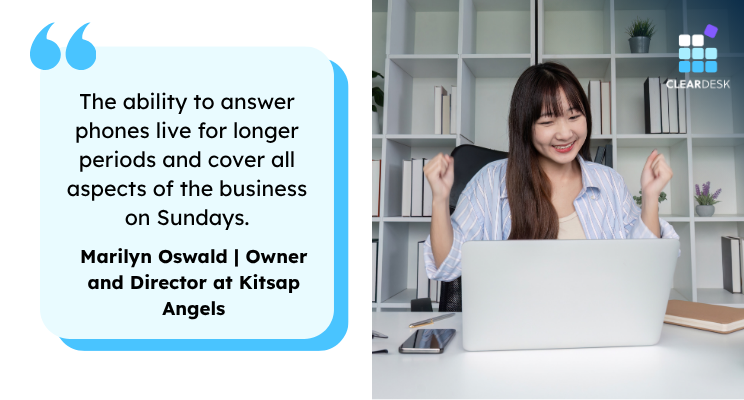
Marilyn Oswald, Owner and Director at Kitsap Angels, noted the direct operational benefit: "The ability to answer phones live for longer periods and cover all aspects of the business on Sundays has been a huge benefit."
Scalable Support as Your Agency Grows
As you add clients, you add VA hours or team members. The process is fast. There's no local job market constraint. Agencies we work with at ClearDesk have scaled from one VA to a full remote coordination team without the delays that come with local hiring.
Challenges of Using Virtual Assistants for After-Hours Coordination
Being direct about challenges is part of how we operate at ClearDesk. Here are the real obstacles and how to address them.
Communication and Time Zone Considerations
Handoffs between your daytime in-office team and your after-hours VA require clear documentation. What happened during the day? What's pending? What does the VA need to know before their shift starts? Agencies that build a simple shift-handoff process into their workflow see the best results. This takes about two weeks to establish and becomes routine quickly.
Training on Agency-Specific Protocols
A VA who is new to your agency needs to learn your escalation procedures, your client preferences, your software setup, and your communication style. This onboarding takes time. Most of our home care placements are fully operational within two to three weeks. Agencies that invest in a structured onboarding process get there faster.
We recommend building a short training document that covers your most common after-hours scenarios. Your VA will refer to it constantly in the first few weeks, and rarely after that.
HIPAA Compliance and Data Security
HIPAA stands for the Health Insurance Portability and Accountability Act. It sets the rules for how protected health information, meaning any data that identifies a patient and relates to their health or care, must be handled. VAs who work with home care agencies must be trained on these rules and must use secure systems to access client data.
At ClearDesk, every VA placed with a healthcare client receives HIPAA training and signs a Business Associate Agreement. With The HIPAA Journal reporting 772 large healthcare data breaches in 2025, you should ask any VA provider about their HIPAA compliance process before signing on.
How to Know If Your Agency Is Ready for Virtual After-Hours Support
Signs Your Current After-Hours Model Is Struggling
If you recognize more than two of these, your current model is not working:
Calls during nights and weekends go unanswered or to voicemail regularly
You've lost coordinators or schedulers because of on-call burnout
You or another manager personally handle after-hours calls on a regular basis
Your overtime costs for existing staff are increasing each quarter
Shift coverage gaps happen frequently because no one is available to coordinate
Questions to Assess Your Readiness
Before moving to virtual after-hours support, ask yourself:
Do we have a scheduling system (AxisCare, HHAeXchange, ClearCare, or similar) that a remote team member can access securely?
Can we define our escalation protocol clearly in writing?
Do we have a list of backup caregivers a VA can contact for open shifts?
Are we open to a two-to-three-week onboarding period before full independence?
Do we have a point of contact who can answer VA questions during the first month?
If you answered yes to all five, you're ready. If you answered no to one or two, those are solvable gaps, not blockers.
Book a Discovery Call to talk through your specific situation and see if virtual after-hours support is the right fit for your agency.
How to Choose a Virtual Assistant Provider for After-Hours Home Care Support

Look for Home Care Industry Experience
A general VA who has never worked in home care will not know what a split shift is, why EVV compliance matters, or how to handle a caregiver who reports a client fall. Industry-specific experience matters enormously for after-hours work, where the stakes are high and decisions happen fast.
Ask providers specifically whether their candidates have worked with home care agencies before. Ask whether they train on home care software.
Verify HIPAA Training and Compliance Standards
Ask every provider these questions:
Do your VAs receive HIPAA training before starting with healthcare clients?
Will the VA sign a Business Associate Agreement?
What systems do you use to ensure secure access to client data?
How do you handle a HIPAA breach if one occurs?
A provider that cannot answer these questions clearly is not a safe choice for home care coordination.
Evaluate Vetting and Quality Assurance Processes
The quality of your VA depends entirely on the quality of the vetting process. Ask how many applications the provider receives, how many they accept, and what their screening process includes. At ClearDesk, we've been recognized in Forbes for remote staffing excellence and maintain a 4.9/5 client satisfaction rating. Our acceptance rate of less than 0.5% means the candidates we present are genuinely exceptional.
Kayla Spurlock, HR and Scheduling Manager at Home Instead, described the result: "She's made such a huge impact on our organization in just three short months. It honestly feels like she's been part of the team much longer."
Confirm Ongoing Support and Performance Management
Some providers place a VA and disappear. That's not how reliable after-hours coverage works. You want a provider that stays involved, monitors performance, and can respond quickly if something isn't working.
At ClearDesk, we maintain active relationships with both clients and VAs after placement. If a VA isn't performing, we address it. If your needs change, we adapt. Reagan King from Home Instead described it this way: "I also appreciate how ClearDesk maintains close communication with both our company and the VA."
How to Build Reliable After-Hours Coverage for Your Home Care Agency
Here is the step-by-step process we walk our home care clients through:
Audit your current after-hours gaps. Document how many calls come in after 5 PM, how many go unanswered, and how many result in missed coverage.
Define your after-hours tasks. List every task that needs to happen after hours, from caregiver call-outs to family inquiries to schedule updates.
Identify your escalation triggers. Decide which situations require a supervisor and document exactly how the VA should escalate.
Select your scheduling software. If you're not yet on AxisCare, HHAeXchange, or ClearCare, choose one before bringing on a VA. Remote coordination depends on a shared, accessible system.
Build your backup caregiver list. Your VA needs a clear list of who to call when a shift opens. This list should be current and accessible in your scheduling system.
Onboard your VA with a structured plan. Spend the first two weeks walking through your most common after-hours scenarios. Role-play calls. Review your escalation protocol together.
Review performance weekly for the first month. Check call logs, schedule accuracy, and escalation handling. Adjust your protocols based on what you learn.
The difference between a VA arrangement that works and one that doesn't almost always comes down to the quality of onboarding and the clarity of your protocols. The coordination tasks themselves are straightforward. The setup is where agencies succeed or stumble.
If you're ready to build a reliable after-hours team without the overhead of in-office staffing, Book a discovery call and we'll show you exactly how it works.
Frequently Asked Questions
Q: How do time zones work when using offshore virtual assistants for after-hours coverage?
A: Virtual assistants based in the Philippines work during their local daytime hours, which align with U.S. evenings and overnight periods. This means your VA is alert and working their normal shift while your U.S. office is closed. You get consistent coverage without asking anyone to work a night shift.
Q: Can a virtual assistant handle both scheduling and caregiver recruitment during after-hours?
A: Yes, trained VAs can manage both functions, though the combination depends on call volume and task load. If your after-hours period is busy with scheduling changes, recruitment tasks are better handled during day hours. Talk to your provider about realistic role scope before combining both responsibilities in one position.
Q: What home care software should a virtual assistant be trained on before starting?
A: The most common platforms in home care scheduling are AxisCare, HHAeXchange, ClearCare, and Alora. Your VA should be trained on whichever system your agency uses. Reputable providers like ClearDesk train VAs on your specific software during onboarding so they're operational quickly.
Q: How do agencies measure virtual assistant performance for after-hours coordination?
A: The most useful metrics are call response rate, time to fill open shifts, scheduling accuracy, and escalation handling. Track how many after-hours calls were answered, how quickly open shifts were covered, and whether escalations followed your protocol correctly. Quality providers offer tools and check-ins to help you monitor these numbers.
Q: What is the typical transition timeline when moving from in-office to virtual after-hours coverage?
A: Most agencies complete the transition within two to three weeks. The first week focuses on onboarding and software access. The second week involves supervised after-hours shifts. By week three, most VAs are handling after-hours coordination independently. Agencies with well-documented protocols move faster.
Q: Does ClearDesk offer part-time virtual assistant placements for after-hours coverage only?
A: ClearDesk places full-time virtual assistants. We don't offer part-time or hourly placements. If your after-hours volume is high enough to justify a full-time team member, which is true for most agencies handling more than 20 active clients, the arrangement delivers strong value. If your volume is very low, we'll tell you that honestly on the discovery call.