Remote Scheduling for Home Care Agencies: A Simple Guide

Updated: 2 days ago

Remote scheduling for home care means a trained professional manages your caregiver schedules, client visits, and shift coverage from a location outside your office. This person handles the same work as an in-house scheduler, but they do it virtually using your existing software and communication tools. You get the same output without the cost of a local hire.
We hear the same story from agency owners every week: the scheduler quits, the owner takes over the schedule, and suddenly there is no time left to run the business. Remote scheduling solves that problem in a way that is faster, more affordable, and more stable than most owners expect.
What Is a Remote Home Care Scheduler?

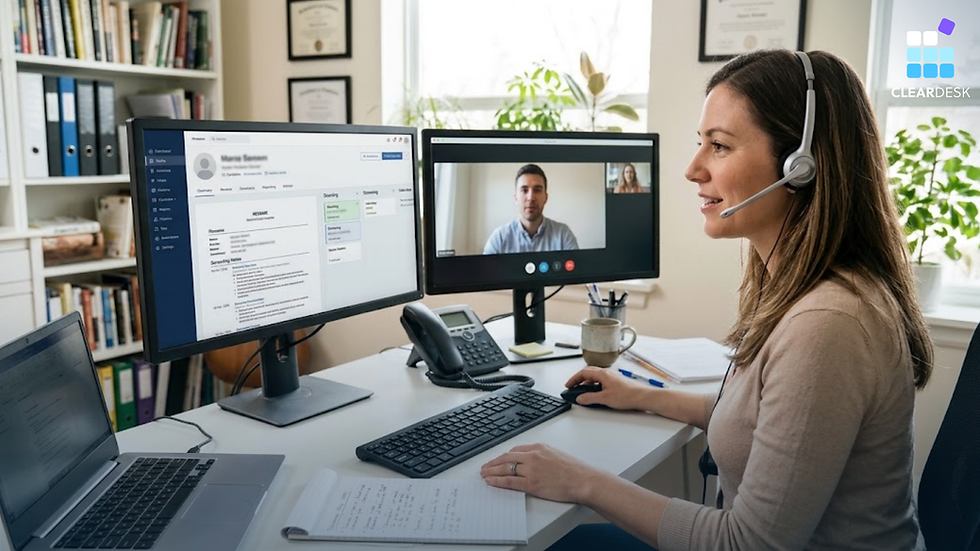
A remote home care scheduler, sometimes called a remote home health scheduler, is a dedicated staff member who coordinates your caregivers and clients from a remote location. They log into your scheduling software each day, manage your shift calendar, respond to caregiver calls, and keep your client visits on track.
This role is not a general virtual assistant. It is a focused position that requires knowledge of home care operations, payer rules, and scheduling tools like AxisCare, WellSky, HHAeXchange, or AlayaCare.
What Remote Home Care Schedulers Do
A remote home care scheduler handles the day-to-day tasks that keep your agency running. Here is a breakdown of their core responsibilities.
Caregiver-Client Matching
Schedulers pair each caregiver with the right client based on availability, skill set, location, and client preferences. A good match reduces conflict and improves retention on both sides. This is not just filling a slot; it is building a working relationship between two people.
Real-Time Schedule Adjustments
When a caregiver calls out sick or a shift changes at the last minute, the scheduler acts immediately. They contact backup caregivers, update the schedule in your software, and notify the client or family. This happens throughout the day, not just during office hours.
Authorization and Compliance Tracking
Schedulers monitor approved visit hours by payer and make sure no client goes over their authorized limit. This protects your agency from claim denials and compliance issues. For Medicaid-funded clients, this step is critical.
No-Show and Call-Out Management

When a caregiver does not show up, the scheduler works down a contact list to find coverage fast. They document the incident, update the record, and make sure the client is not left without care. Speed and accuracy both matter here.
Overtime and Coverage Optimization
Schedulers track caregiver hours to prevent overtime and spread shifts fairly. This keeps labor costs in check and reduces burnout, especially when recruiting one caregiver costs $2,600–$5,000. A well-managed schedule also improves caregiver satisfaction, which directly affects retention amid industry-wide turnover of 75.5%.
Key Skills to Look For in a Remote Home Health Scheduler
Hiring the right person means looking beyond general admin experience. These are the skills that matter most in this role.
Communication and Responsiveness
Remote schedulers work almost entirely through calls, texts, and messages. They need to be clear, calm, and fast. A scheduler who takes two hours to return a call-out message is a liability.
Home Care Software Proficiency
Look for candidates who already know platforms like WellSky, HHAeXchange, AlayaCare, or AxisCare. If they need to learn your system, onboarding takes longer and errors are more likely early on.
Problem-Solving Under Pressure
Schedules fall apart without warning. A good scheduler stays calm, thinks fast, and finds a solution before the client is affected. This is not a role for someone who freezes under pressure.
Attention to Detail
One wrong entry in your scheduling software can trigger a compliance issue or a missed visit. Accuracy in data entry, authorization tracking, and shift documentation is non-negotiable.
Empathy and Professionalism
Schedulers talk to caregivers who are overwhelmed and clients who are anxious. The tone they use in those moments shapes how your agency is perceived. Professionalism and genuine care are both required.
Finding someone who checks all these boxes on your own is hard. At ClearDesk, we process more than 55,000 applications per quarter and accept less than 0.5% of candidates. That filter exists so our clients do not have to do the hard screening themselves.
Benefits of Remote Scheduling for Home Care Agencies
Many agency owners hesitate to move scheduling off-site. Once they do, most wish they had done it sooner.
Cost Savings Compared to Local Hires
A full-time in-office scheduler in the U.S. costs between $40,000 and $55,000 per year in salary alone, before you add benefits, payroll taxes, and office overhead. A remote scheduler, especially one based in the Philippines, can deliver the same quality of work at a fraction of that cost. ClearDesk remote team members start at $2,500 per month with no long-term contract required—use the cost saving calculator to estimate the difference based on your current staffing spend.
Access to a Larger Talent Pool
When you hire locally, you are limited to who lives within driving distance and is willing to do a high-stress scheduling job. When you hire remotely, you can choose from a global pool of candidates with direct home care experience.
Reduced Turnover and Burnout
In-house schedulers often juggle multiple admin responsibilities at once, from scheduling and intake to HR and phone coverage. That workload leads to burnout and frequent turnover. A remote scheduler with a defined role and proper support tends to stay longer and perform more consistently.
Heather Tabares, VP of Operations at Comfort Keepers, shared this about their remote scheduling team: "Our clients and caregivers have formed genuine connections with them and often ask for them by name. They are also wonderfully adaptable and always willing to learn, adjust, and grow with the needs of our business."
Extended Coverage Hours
If your remote scheduler works in a different time zone, you can cover early morning and evening hours without paying overtime. This matters for agencies that need on-call support outside of standard business hours.
Scalability as Your Agency Grows
You can add remote schedulers one at a time as your client census grows. You do not need to hire a full-time employee every time your volume increases by 10 clients. That flexibility protects your margins and supports scalable growth.
Common Challenges With Remote Scheduling and How to Address Them
Remote scheduling works well when you plan for the most common friction points. Here is what to expect and how to handle each one.
Challenge: Communication gaps between the remote scheduler and your in-house team. Solution: Set a daily check-in via Slack or Teams. Define who the scheduler reports to and how urgent issues get escalated. Clear channels prevent missed messages.
Challenge: Time zone coordination when your agency needs coverage during specific hours. Solution: Hire schedulers whose working hours overlap with your busiest shift windows. Many agencies prefer schedulers who cover early morning or Sunday on-call, which are hard to staff locally.
Challenge: Trust and accountability without physical oversight. Solution: Use time-tracking tools and set measurable daily goals. Review shift fill rates, response times, and documentation accuracy weekly. Numbers tell you more than observation does.
Challenge: Technology issues that disrupt access to scheduling software. Solution: Confirm your remote scheduler has a reliable internet connection and a backup plan. Require a minimum internet speed before hiring. Provide VPN access if your software requires it.
Why Home Care Agencies Trust Offshore Remote Schedulers
More home care agencies are hiring schedulers from the Philippines, and the results speak for themselves. Filipino professionals bring strong English skills, a deep sense of service, and direct experience in healthcare administration. Many have worked with U.S.-based home care agencies and already know platforms like WellSky and HHAeXchange.
The cultural fit is also strong. Filipino professionals tend to be proactive, thorough, and relationship-focused. Those traits matter in a scheduling role where you are managing caregivers and clients who are under stress.
Tom Margolis from Interim HealthCare put it plainly: "We have an outstanding scheduler that has consistently outperformed most, if not all, the employees we had doing this job previously."
That result comes from proper vetting and training. At ClearDesk, every candidate goes through a rigorous screening process before they are ever presented to a client. We have been recognized by Forbes for our approach to remote staffing, and our 4.9/5 client satisfaction score reflects the quality of the matches we make.
Vetted offshore talent performs at the same level as local hires when they receive proper onboarding and clear expectations. The location does not determine the quality. The process does.
If you want to see how this works in practice, explore our home care virtual assistant services for a full breakdown of what these roles can cover.
Ready to find your next remote scheduler? Book a Discovery Call and we will walk you through the process.
How to Hire a Remote Scheduler for Your Home Care Agency
Here is the step-by-step process we recommend for agencies that are ready to hire.
1. Define the Role and Responsibilities
Write a clear job description before you start. List the exact tasks you need covered, the software your scheduler must know, the hours you need them to work, and any compliance requirements specific to your state or payer mix. Vague job descriptions attract the wrong candidates.
2. Decide Between Direct Hire or Staffing Partner
You can hire a remote scheduler on your own through job boards or a staffing partner who handles sourcing, screening, and ongoing support. Direct hiring gives you more control but requires more time and carries more risk. A staffing partner reduces that risk and gets you to a qualified candidate faster. At ClearDesk, we typically present matched candidates within one to two weeks.
3. Vet Candidates for Skills and Cultural Fit
Assess scheduling experience, software knowledge, communication style, and how they handle pressure. Ask them to walk through how they would handle a last-minute call-out. Their answer tells you more than their resume does.
4. Onboard and Train for Your Workflow
Do not assume a skilled scheduler will figure out your system on their own. Spend the first week walking through your software, your client roster, your caregiver pool, and your escalation process. Use screen sharing and recorded walkthroughs so they can reference them later.
Kayla Spurlock, HR and Scheduling Manager at Home Instead, described the impact of a well-matched and properly onboarded remote scheduler this way: "She's made such a huge impact on our organization in just three short months. It honestly feels like she's been part of the team much longer."
5. Set Clear Expectations and Communication Cadence
Define daily priorities, response time standards, and how performance will be measured. Set a weekly check-in to review shift fill rates, open gaps, and any issues that came up. Consistent touchpoints keep the relationship strong and catch problems early.
Software and Tools Remote Home Care Schedulers Use
A qualified remote scheduler should be comfortable with the tools your agency already uses. Here are the most common platforms and tools in this space.
Scheduling and Care Management Software:
WellSky Personal Care
HHAeXchange
AlayaCare
AxisCare
ClearCare (now part of WellSky)
Communication Tools:
Slack
Microsoft Teams
Zoom
Time Tracking and Accountability:
Time Doctor
Hubstaff
Secure File Sharing:
Google Workspace (with HIPAA Business Associate Agreement)
Microsoft 365
Here is a quick comparison of the most common scheduling platforms used in home care:
Platform | Best For | EVV Support | Medicaid Billing | Mobile App |
WellSky | Mid to large agencies | Yes | Yes | Yes |
HHAeXchange | Medicaid-focused agencies | Yes | Yes | Yes |
AxisCare | Private pay and Medicaid | Yes | Yes | Yes |
AlayaCare | Growing agencies with complex needs | Yes | Yes | Yes |
HIPAA Compliance and Remote Scheduling

HIPAA stands for the Health Insurance Portability and Accountability Act. It sets the rules for how protected health information, meaning any data that identifies a patient, must be stored and shared. Remote schedulers handle this type of information every day, including client names, diagnoses, visit records, and payer details.
A remote scheduler must follow strict protocols to stay compliant, with healthcare breaches averaging $7.42 million per incident. Key requirements include:
Working on a secure, password-protected device
Using a VPN when accessing your scheduling software
Signing a Business Associate Agreement before starting work
Completing HIPAA training before handling any client data
Using only approved, encrypted tools for communication and file sharing
At ClearDesk, every remote team member goes through HIPAA compliance training as part of their onboarding. We do not place candidates who have not completed this step.
If you work with a staffing partner, confirm that HIPAA training and signed agreements are part of their standard process. If they cannot confirm this, that is a red flag.
Build a Stronger Scheduling Team for Your Home Care Agency
Remote scheduling is not a workaround. It is a real solution for agencies that are losing time, money, and staff to a broken scheduling process.
We have worked with agencies of every size, from small private-pay operations to multi-location Medicaid providers. The pattern we see most often is this: the owner is doing too much, the in-house scheduler is overwhelmed, and client care is starting to suffer as a result. A trained remote scheduler changes that within weeks, not months.
Jeff Pitts, Owner and CEO of Comfort Keepers Western Colorado, described the shift clearly: "His work ethic, documentation, and collaboration with the scheduling team have made a meaningful impact on our day-to-day operations."
That kind of impact is repeatable when you hire the right person and set them up well.
If your agency is struggling with scheduler turnover, coverage gaps, or rising labor costs, a remote scheduler is worth a serious look. The cost is lower than a local hire, the talent pool is broader, and the results hold up.
Book a Discovery Call to see how ClearDesk can match you with a trained, HIPAA-compliant remote scheduler who is ready to work in your system.
Frequently Asked Questions
Q: How long does it take to onboard a remote home care scheduler? A: Most remote schedulers reach full productivity within one to two weeks. The timeline depends on how complex your workflows are and how much time you invest in the first few days of training. Agencies that use screen sharing and recorded walkthroughs tend to see faster results.
Q: Can a remote scheduler work within my agency's existing scheduling software? A: Yes. Experienced remote schedulers are typically trained on the most common home care platforms, including WellSky, HHAeXchange, AxisCare, and AlayaCare. If your platform is less common, plan for a short learning curve during the first week.
Q: What time zone should my remote home care scheduler work in? A: This depends on your coverage needs. Many agency owners prefer schedulers who overlap with their core business hours. Others use time zone differences to their advantage by covering early morning or Sunday on-call shifts that are hard to staff locally.
Q: How do I manage accountability with a remote home care scheduler? A: Set measurable daily goals, use a time-tracking tool, and schedule a weekly check-in to review performance. Track metrics like shift fill rate, response time to call-outs, and documentation accuracy. Numbers give you a clear picture without requiring you to watch over someone's shoulder.
Q: What happens if my remote scheduler leaves or underperforms?
A: If you hire through a staffing partner like ClearDesk, we handle the replacement process for you. We vet new candidates quickly and manage the transition so your operations are not disrupted. This is one of the main reasons agencies choose a staffing partner over a direct hire.
Q: Is remote scheduling a good fit for a small home care agency? A: Yes. Agencies with as few as 10 to 15 active clients benefit from dedicated remote scheduling support. It frees up the owner's time and creates a more consistent experience for caregivers and clients. You do not need to be a large agency to see a real return.